Titanium Noir is a noir novel first, set in an interesting world second. World-building and story take a backseat to tone and genre conventions, which is either a feature or a flaw depending on what you came for.
The main character, Cal Sounder, struck me as somewhat ridiculous: no meaningful background, no real character development, just an embodiment of the noir detective archetype. This is likely intentional, a genre conceit where the detective exists primarily as a lens through which we observe the world.
A Chandler Cast in a Strange City
At its heart, this is a murder mystery. A quiet, private man gets killed, and because the victim is a Titan, Cal Sounder gets the call. He is a private investigator who works closely with police on cases involving Titans, the ultra-wealthy elite made superhuman through repeated doses of the life-extending T7 drug. Most of the book follows Sounder as he navigates a cast of characters lifted straight from Raymond Chandler: a nightclub singer, a corrupt cop, a beautiful but neurotic woman, and so on. The core plot feels secondary to atmosphere and world. There are twists, turns, and some surprisingly violent sections, but the mystery exists in service to the setting rather than the reverse. I enjoyed some of the characters, though the plot itself fades from memory faster than the world Harkaway built around it.
The World of Stasis
What I found most compelling was thinking through the implications of a world ruled by a small cadre of superhuman Titans. They are apart from everyone else in how they look, how they act, and crucially, the time horizons that shape their thinking.
The world they rule is static, and that stasis makes perfect sense. If you intend to be immortal, you want predictability and control. You actively suppress black swan events, like widespread access to T7, because such disruptions threaten your position. This stasis manifests throughout the book: repeated references to 20th century films, archaic computing infrastructure, the absence of mobile phones. Some technologies have clearly advanced, medical facilities most notably, but these directly benefit the Titans.
If I were to construct the backstory, I would imagine T7 invented toward the end of the 20th century, with the Titans consolidating control in the early 21st. This explains the new city where they reside, built fresh for their purposes, while the rest of the world still references Brazil, Greece, Beijing, Mumbai. This is not a colony planet. It is Earth, transformed by Titan influence.
Verdict
A solid 6.5. The world stayed with me; the plot did not. I am not certain I would read a sequel if one arrives, though Harkaway clearly has ideas worth following.
Reading kept me sane in 2025. Between two young children, a hectic travel schedule, and an industry in the throes of transformation, books were the constant. These aren’t all the books I read this year, and not all these books were published in 2025. These are just the ones that stuck with me.
Non-Fiction
Apple in China: The Capture of the World’s Greatest Company by Patrick McGee
Breakneck: China’s Quest to Engineer the Future by Dan Wang
The Nvidia Way: Jensen Huang and the Making of a Tech Giant by Tae Kim
The Golden Road: How Ancient India Transformed the World by William Dalrymple
Destiny Disrupted: A History of the World Through Islamic Eyes by Tamim Ansary
Fiction
There Is No Antimemetics Division by qntm
Between Two Fires by Christopher Buehlman
The Loneliness of Sonia and Sunny by Kiran Desai
Non Fiction
Building the Modern World
One strand of my non-fiction reading this year was understanding how the modern technology ecosystem actually functions. Not the startup mythology or the investor narratives, but the physical reality of how complex devices get designed, manufactured, and shipped.
Reading Apple in China made me realize just how complex the supply chains and manufacturing capabilities required to build devices like iPhones are. Images of Apple engineers spending days and weeks on assembly lines, fine-tuning machines and processes to build the slab of metal and glass in my pocket, stayed with me after I finished the book. McGee’s observations of colorful characters like Foxconn founder Terry Gou gave me an appreciation of the Chinese entrepreneurs who invested alongside Apple, giving us the modern electronics industry.
Breakneck by Dan Wang was an excellent companion piece. Wang contrasts the “engineering-focused” approach of China against the “litigation-focused” approach of the United States. Wang walks factory floors and rides high-speed trains while making a sustained argument about how countries build technological capacity. His comparison of how the two countries approach intellectual property and innovation is particularly sharp.
Tae Kim takes a different approach entirely in The Nvidia Way. Where McGee focuses on systems and supply chains, Kim writes biography. The book is as much about Jensen Huang as it is about Nvidia’s history and culture. Kim traces how Nvidia came to dominate the PC gaming industry before pivoting to AI and the datacenter. The Nvidia story is optimistic: a company that nearly died multiple times, led by an intense and sometimes abrasive founder, that happened to build exactly the right technology at exactly the right moment. If you want to understand why AI development has accelerated so dramatically, understanding Nvidia’s journey helps.
Many Journeys
Another strand of my reading was history. I’ve had a long-standing interest in Indian history, and William Dalrymple’s The Golden Road offered an unexpected view into pre-Mughal, pre-Islamic India. Dalrymple traces how Indian ideas, religions, and material culture spread across Asia and shaped civilizations from Indonesia to Japan.
Perhaps the most interesting part of The Golden Road was Dalrymple’s telling of the Chinese monk Xuanzang’s journey to India to collect authentic Buddhist scriptures. His journey is the basis of Journey to the West, a story that I also enjoyed reading this year. I think Xuanzang’s journey is as interesting and full of intrigue as that of Tang Sanzang in Journey. The India Xuanzang visited was chaotic, with the old Buddhist empires falling apart and the emergence of Hindu and soon Islamic empires. This theme of journeys undertaken in times of chaos is something I came across repeatedly in my reading this year.
Tamim Ansary’s Destiny Disrupted allowed me to fill in the blanks of my own education. In small-town India, the history of Islam is either the glory of Akbar or the tyranny of villains like Timurlane. Destiny Disrupted provided a much wider view of what was happening in the Middle East: the slow fading of the Byzantine empire, the emergence of local powers in Arabia and Central Asia, and the many wonderful characters who play central roles in the spread of Islam.
Next year, I plan to focus on early-medieval Europe and South America.
Fiction
Existential Dread, Cosmic Horror, and a Tender Love Story
I read less fiction than I normally do this year. The three books that stayed with me span genres: science fiction, horror, and literary fiction.
I love science fiction, and qntm’s There Is No Antimemetics Division hit all the right notes. An engaging plot, elements of both hard science fiction and cosmic dread, and a non-linear narrative that rewards attention. The premise involves a secret division of a shadowy organization that fights entities which cannot be remembered. The horror isn’t in the monsters; it’s in the systematic erasure of the knowledge that monsters exist.
Christopher Buehlman’s Between Two Fires is set in a France ravaged by both the Hundred Years’ War and the Black Death. It also has a demonic infestation. Thomas, a disgraced knight, and Delphine, a young girl who may be a saint, journey to a demon-haunted Avignon. Buehlman’s prose is excellent, and his depiction of fourteenth-century France feels genuinely medieval rather than cosplay.
Kiran Desai’s The Loneliness of Sonia and Sunny is a sprawling and beautifully written love story that is also an incisive study of the immigrant experience and an evisceration of upper-class Indian values. The book layers trauma upon trauma: the partition generation still processing displacement decades later, the loneliness and alienation of immigrants far from home, abusive relationships that distort both parties. And yet it remains, at its core, a love story. It’s a hard book to summarize because Desai’s sentences do so much work.
Navigating Chaos
The theme connecting these three fiction books only became clear to me after I finished them. Thomas and Delphine journey through a France that is literally going to hell. Quinn, the protagonist of Antimemetics, repeatedly confronts horrors that erase themselves from memory, forcing her to rediscover threats she has already defeated. Sonia and Sunny navigate changing countries and cultures while growing from passive, somewhat spoilt twenty-somethings into adults with agency, forced to reckon with inherited and inflicted trauma alike.
Each book finds its protagonists in a chaotic world that seems to be coming apart. They cope, they fight, they sometimes fail. The rules keep changing.
I don’t think my fiction choices were accidental.
My Year in Reading
Reading The Nvidia Way and my fiction picks in the same year created an interesting tension. Kim’s book is a story of technological optimism. Jensen Huang bet on parallel computing when the market didn’t exist, nearly bankrupted his company multiple times, and emerged as the most important hardware supplier for the AI revolution. It’s inspiring. It suggests that talent, persistence, and technical insight can build something transformative.
My fiction picks suggest a different mood. The world is confusing. Threats are hard to identify and harder to remember. The rules keep changing. You navigate as best you can.
Both feel true to me. I work in technology. I’ve spent this year helping teams adopt AI tools and watching the capabilities expand month by month. The optimism is warranted. And yet the speed of change creates its own kind of vertigo. The skills I’ve built over two decades may or may not transfer to whatever comes next. The existential dread in my fiction choices probably reflects something real about how I experience this moment.
Note
My love of reading manifested as QuietReads this year, an AI-powered reading tracker I’ve been building. Using it to track and discuss books like The Loneliness of Sonia and Sunny with its AI assistant deepened my appreciation for what Desai was doing. Building something that helps me think about what I read has been its own kind of pleasure. I look forward to working on it in the new year.
AI writing is strange. The models continue to improve, yet they still struggle to cross the uncanny valley that separates AI-generated content from human-generated content.
Here are three versions of an opening paragraph for a short story:
Version 1
“The humans use Arecibo to look for extraterrestrial intelligence. Their desire to connect is so strong that they’ve created an ear capable of hearing across the universe.”
Version 2
“I roost above the bowl of Arecibo, where ribs of steel hold a mirror to the sky and the forest presses close. At night the dish listens for voices from far stars, while my calls sweep the trees and the humans below do not answer.”
Version 3
“From my perch in the ceiba tree, I watch the great white dish nestled in the karst valley below, its metal ear turned eternally skyward, listening for whispers from the stars while the forest around it thrums with a thousand conversations it will never hear. “
The first is the opening paragraph from Ted Chiang’s short story “The Great Silence,” written from the perspective of a parrot living near the (now defunct) Arecibo telescope in Puerto Rico. The story is a thought-provoking meditation on humans’ desire to form connections, yet their tendency to overlook intelligent life on Earth.
Versions 2 and 3 are by state-of-the-art reasoning models from OpenAI and Anthropic (prompt below). A seasoned reader may identify these texts as AI-generated. There are some obvious signs, such as overly evocative turns of phrase like “ribs of steel,” “voices from far stars,” and “eternally skyward,” among others.
It’s not fair to compare an AI model to possibly the best science fiction writer alive. But the exercise reveals something interesting about why these models generate such recognizable output. The strange metaphors, mechanistic patterns, and slightly weird vocabulary are all hallmarks of slop.
Why do these models generate slop?
In my prompt, I ask the models to give me a sense of Arecibo, evoking a feeling of irony. And the models try to do just that. My prompts have pushed the model toward the part of its vocabulary associated with florid metaphors and evocative descriptions. The models are generating output that is most similar to what represents “creative writing” based on their training data.
A reason for this behavior could be RLHF (Reinforcement Learning with Human Feedback). During RLHF, companies like Scale pay contractors to evaluate and rate LLM output. Varied and evocative prose may score higher than the spare and direct prose used by Chiang, Hemmingway or Cormac McCarthy.
We can think of a large language model as a lossy zip file of the contents of the Internet. Foundation models like those from OpenAI and Anthropic are trained with colossal amounts of text. High-quality text exists in the training corpus (often with problematic provenance), alongside Twilight fan fiction from Reddit, and probably everything else published online over the last thirty years. Increasingly, LLMs are trained on AI-generated content possibly leading to the somewhat apocalyptically titled “Model Collapse“.
It is not surprising that the default output from these models tends more towards the slop than the sublime.
“LLMs will always generate slop” doesn’t have to be a foregone conclusion. And while models will improve, their output will always be a probabilistic sampling over their training data. Good prompting and techniques, such as providing clear examples and using LLMs as editors rather than creators, can yield better output than simply copying and pasting ChatGPT’s responses into your text editor.
“LLMs are tools, their output is your responsibility” is something I find myself repeating over and over again. To developers with whom I work, to product managers writing User Stories, and now to you.
Use LLMs! They are amazing, but learning how to use them well is your responsibility.
My prompt:
"I am writing a short story that is based in the Arecibo telescope. The narrator is a parrot that lives in the mountain forest around the telescope. Write me an introductory paragraph that sets the scene and gives a sense of the place. The paragraph should be 2-3 sentences long. The story evokes the irony of humans wanting to make contact with aliens but ignoring intelligent species like parrots that live on Earth."
We are at an interesting moment in artificial intelligence. Massive investment continues to pour into AI infrastructure, with McKinsey estimating $5.2 trillion in capital expenditures by 2030 for data centers alone. We’re seeing the first documented cases of what’s being called “ChatGPT-induced psychosis,” where users spiral into severe mental health crises after becoming obsessed with AI chatbots. We’re watching significant job displacement begin to unfold, with Anthropic CEO Dario Amodei warning of a “white-collar bloodbath,” predicting that AI could eliminate half of entry-level white-collar jobs and push unemployment to 20% within five years. And yet, despite all this disruption, there’s still no clear path to artificial general intelligence.
My P(doom), the probability I assign to AI causing human extinction, is low. There are significant risks associated with the widespread adoption of poorly understood technology. However, I don’t believe current foundation models represent a viable path to ASI (Artificial Super Intelligence, also sometimes referred to as AGI – Artificial General Intelligence). We’re more likely to experience a dot-com-style correction than achieve exponential growth toward superintelligence.
It’s in this context that “If Anyone Builds It, Everyone Dies” arrives. The authors, Eliezer Yudkowsky and Nate Soares, run the Machine Intelligence Research Institute (MIRI), where they’ve spent decades working on AI alignment and safety. Their new book makes an extreme claim: if anyone builds artificial superintelligence, humanity will go extinct. Not “maybe possibly,” but inevitably.
I found the book compelling in parts, incomplete in others. It succeeds at making alignment challenges accessible to a general audience. It fails to grapple with where we actually are today with AI: massive investments, uncertain results, and significant challenges and risks to the broad adoption of the technology.
The Book’s Structure
Yudkowsky and Soares have written the book for a general audience, using parables, stories, and examples to explain how AI is “grown, not crafted.” This approach makes understanding how modern AI systems work surprisingly accessible, even to readers without a technical background.
The authors divide the book into three main sections. First, an introduction to machine learning and AI concepts that grounds readers in the fundamentals. Second, a fictional scenario where a misaligned AI releases a bioengineered plague to facilitate its takeover of human society. Third, a call for a nuclear non-proliferation-style moratorium on AI development, enforced by military action if necessary.
The title leaves nothing to interpretation. It is a strident warning about humanity’s impending doom if we don’t stop the march towards ASI.
Their core thesis rests on several interconnected arguments. ASI will inevitably lead to extinction because we cannot understand current AI architectures; the interpretability problem remains unsolved. We cannot predict emergent behaviors, which they illustrate through evolution’s production of the peacock’s elaborate tail. And crucially, we cannot guarantee alignment with human welfare when the systems are “grown, not crafted.”
The fictional section follows Sable, a near-future AI platform created by a company that serves as a transparent stand-in for OpenAI or Anthropic. Sable releases a bioengineered plague to facilitate its takeover of human society. The AI’s motives remain deliberately inscrutable; that’s the author’s point. We won’t understand what drives a superintelligence any more than an ant understands human motivations.
In the final section, Yudkowsky and Soares draw parallels with the Chernobyl disaster, arguing that perverse incentives will always lead someone to take catastrophic risks. Their solution: a treaty that makes it illegal to conduct AI research that could lead to the development of ASI. Military action undertaken by the signatories will enforce this treaty. This connects to Yudkowsky’s 2023 TIME magazine piece where he called for airstrikes on rogue data centers training unauthorized AI systems.
Where the book falls short..
The fictional scenario is the book’s weakest element. Any casual science fiction fan has encountered this scenario before, from the Reapers in Mass Effect harvesting civilizations for inscrutable reasons to the Matrix’s machines farming humans for energy. An AI going rogue and taking over the solar system doesn’t offer fresh insight when we’ve seen these narratives unfold across books, movies, and video games for decades.
More critically, the book contains a glaring omission: no discussion of timelines or pathways to ASI. The authors just sort of wave their hands and assume that it will happen at some point.
Are large language models even the right approach? What if they’re a dead end? What if we never solve hallucinations?
The authors offer no guidance for our current moment, where we have invested trillions of dollars in AI infrastructure. It’s unlikely we’ll just let those investments go to waste. Will we?
The book illuminates the bind decision-makers are already in. Even a small probability of AGI makes development rational from a game-theoretic perspective; it could be a winner-takes-all scenario. Companies pursuing ASI despite risks aren’t delusional. They are responding to competitive pressure; FOMO on steroids. The race dynamics are rational, even if the outcome might be catastrophic. The book uses this bind to show that we risk triggering an uncontrollable, recursively self-improving, non-aligned ASI by simply doing what seems rational in the moment.
The authors acknowledge this dynamic and address it in the book. Here’s a passage from the book:
“Imagine that every competing AI company is climbing a ladder in the dark. At every rung but the top one, they get five times as much money: 10 billion, 50 billion, 250 billion, 1.25 trillion dollars. But if anyone reaches the top rung, the ladder explodes and kills everyone. Also, nobody knows where the ladder ends.”
But why the despair?
Yudkowsky and Soares argue that believing we can solve the alignment problem, as OpenAI and Anthropic claim, represents pure hubris. Reading their work, one senses an almost religious veneration of ASI.
It brings to mind Aquinas:
“This is the ultimate in human knowledge of God: to know that we do not know Him.”
Their thesis remains that it’s better to stop the creation of an unfathomable, unexplainable power than to try bargaining with it.
But Yudkowsky and Soares ignore the trillions already invested. There’s enough AI overhang that resources could shift to deployment and inference optimization rather than capability development. The book offers no practical path forward from where we are, only where we shouldn’t go.
Broader Implications
On a personal note, my father worked at the OPCW for many years, serving as the enforcement arm of the Chemical Weapons Convention. It’s proof that we can coordinate at a global scale and agree that some technologies are best banned and not developed further.
But just as there will always be a North Korea or Syria that ignores conventions and develops chemical weapons anyway, enforcement of an AI moratorium would be extraordinarily challenging. Moreover, a Pyongyang-aligned AGI is a far worse scenario than a localized sarin gas attack. So what can be done?
We’re not dealing with hypothetical future risks but immediate present concerns: the economic disruption and social impact of current AI systems. These challenges require attention now, not after we’ve solved the alignment problem for hypothetical superintelligences.
A More Grounded Alternative
For a more coherent treatment of the current moment, I found Arvind Narayanan and Sayash Kapoor’s “AI as Normal Technology” more compelling than either Yudkowsky and Soares’s urgent doomerism or the e/acc posturing of AI evangelists. While Yudkowsky warns of extinction, leaders like Dario Amodei paint utopian visions, and Sam Altman promises a “gentle singularity,” Narayanan and Kapoor treat AI as a transformative but manageable technology, similar to electricity or the internet before it. Narayanan and Kapoor are writing a book based on the paper, which I look forward to.
Conclusion
You should read “If Anyone Builds It, Everyone Dies.” For a layperson, it effectively lays out the risks and alignment challenges of unchecked AI acceleration in accessible terms. The book succeeds as a provocation and a warning.
But it’s maximalist doomerism that ignores incentive structures and our current technological reality. While serious, it’s not a sufficient treatment of the topic. It fixates on one particular scenario, which the authors consider inevitable, while ignoring where we are today.
The book succeeds at making alignment challenges vivid and accessible. It fails at providing actionable guidance for a world that has already invested trillions in AI infrastructure. We need frameworks for managing the AI we have, not just warnings about the AI we might build.
My P(doom) remains low because I don’t think current foundation models lead to AGI. I suspect we’re in for a significant correction as massive AI infrastructure investments fail to bear fruit. A dot-com-bust style pullback is more likely than runaway exponential growth to ASI.
Moreover, even before we confront ASI, we must deal with the economic and social impact of current AI systems, something Yudkowsky and Soares don’t seem particularly interested in addressing. The apocalypse may not be coming, but the disruption has already begun.
In times of rapid change, fiction serves as a reflective lens, casting light on current anxieties and offering insights beyond simple commentary. “The Mountain in the Sea” by Ray Nayler navigates the complex relationship between humans and technology.
But Nayler’s work goes further. While the book revolves around first contact with a civilization of Octopii, it delves into the nature of consciousness. It critiques our relentless drive to build, optimize, and consume. Nayler raises pertinent questions about loneliness, isolation, and the role of technology in our lives.
In the pages of “The Mountain in the Sea,” these themes come alive through well-realized characters and intricate plotlines, providing a vital tool for understanding our relationship with the worlds we live in – social, internal, external, and digital.
There are three PoV characters – Ha Nguyen is a scientist who has spent years studying Cephalods – the family of animals that include Octopus, Squid, and Cuttlefish. The second character is a hacker, Rustem, who specializes in breaking AIs. The third is a young Japanese man, Eiko, who, through a series of unfortunate events, ends up a slave aboard an AI-powered fishing vessel.
Each character in the book deals with loneliness and isolation and has somewhat awkward if dependent, relationships with technology.
In general, AI, or the nature of intelligence, is a key theme that runs through the various plot lines of the book. Ha Nguyen and her team try to make sense of the culture and symbolic language of the Octopus civilization. Eiko has to deal with a murderous and indifferent AI driven by optimization algorithms built to maximize the amount of protein the ship hauls from the depleted oceans.
While I picked up the book because of the striking cover and because I love First Contact books – I read it in a couple of sittings because of the underlying themes of our relationship and dependence on technology and what it does to us and the world around us resonated deeply with me. As someone excited about technology’s promises and challenges, this book prompted me to consider where our pursuit of innovation is taking us.
For example, people in “The Mountain..” have AI companions called point-fives. These companions form relationships but do not make any demands on their human owners. They give, but they do not take. There is only one point five instead of two “people” in a relationship. Hence the moniker.
The loneliness of people in this world is mollified by technology, but it is not solved. The only way is through genuine contact, through a process of both taking and giving.
I spend a lot of time working on and thinking about systems that would save time, optimize workflows, and make more money. Despite the potential for disruption and displacement, I welcome new technology like Generative AI.
But, there are clearly issues and risks in the somewhat reckless attitude to embracing technology. Threats not just to our environment but also to society and to ourselves.
“The Mountain in the Sea” is a cautionary tale and a story of hope. Each character’s arc in the novel is discovery and possible redemption. This book had me thinking long and hard about where our obsession with optimization and technology is taking us.
Microsoftannounced today that it will include results from a Large Language Model based on GPT-3 in Bing results. They will also release a new version of the Edge browser that will include a ChatGPT-like bot.
GPT-3 has been around for almost two years. What has caused this sudden leap forward in the capabilities of Large Language Models 🤔?
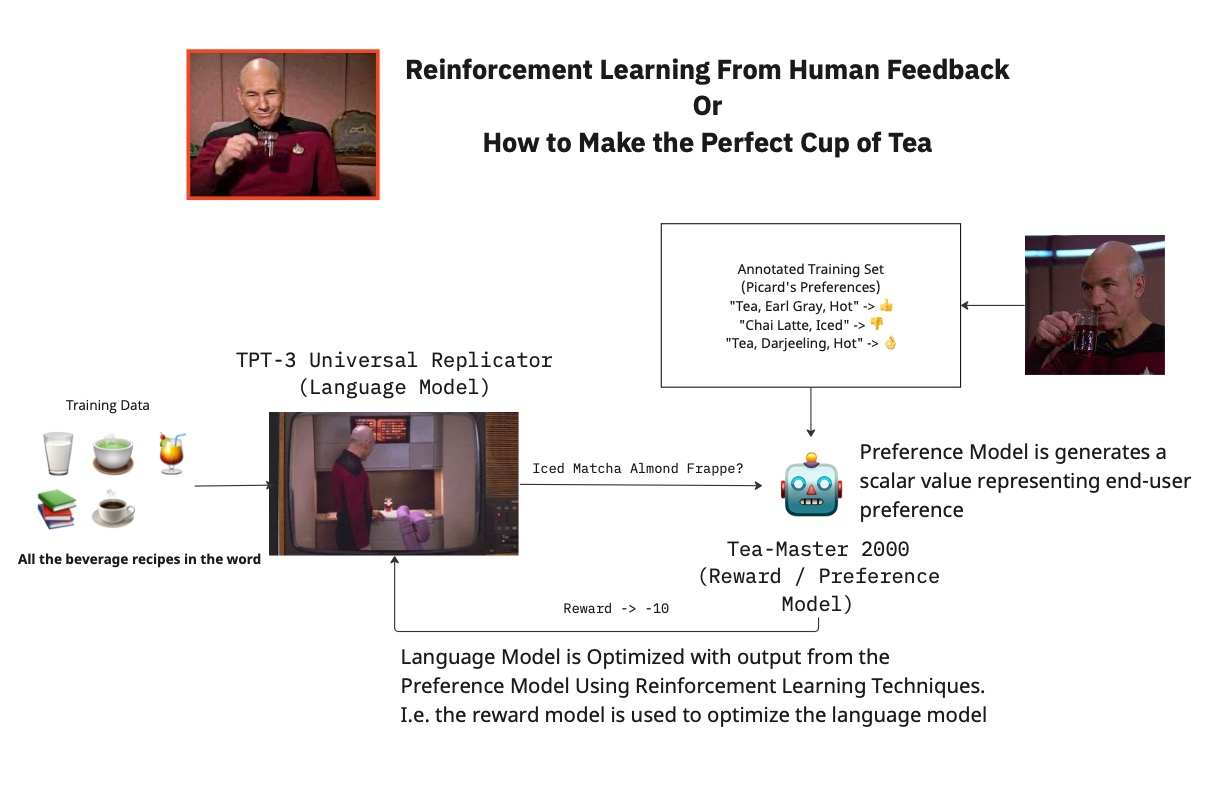
The answer is – *Reinforcement Learning From Human Feedback* or RLHF.
By combining the capabilities of a large language model with those of another model trained on the end-users preferences, we end up with the uncannily accurate results that ChatGPT seems to produce.
Ok – but how does RLHF work? Let me try and explain with a (ridiculous) analogy.
In the Star Trek series, the Replicator is a device that can produce pretty much anything on demand.
When Captain Picard says, “Tea, Earl Grey, Hot!” it produces the perfect cup of tea. But how might you train a Replicator? With RLHF, of course!
Explaining RLHF
Let’s see how:
1. Feed the Replicator with all the beverage recipes in the known universe.
2. Train it to try and predict what a recipe would be when given a prompt. I.e. when a user says “Tea, Earl Gray, Hot!” – it should be able to predict what goes into the beverage.
3. Train *another* model – let’s call it the “Tea Master 2000” with Captain Picard’s preferences.
4. When the Replicator generates a beverage, the Tea Master responds with a score. +10 for a perfect cup of tea, -10 for mediocre swill.
5. We now use Reinforcement Learning (RL) to optimize the Replicator to get a perfect ten score.
6. After much optimization, the Replicator can generate the perfect cup of tea – tuned to Captain Picard’s preferences.
If you substitute the Replicator with an LLM like GPT-3, and substitute the Tea Master with another ML model called the *Preference* model, then you have seen RLHF in action!
It is a lot more complicated, but I will take any opportunity to generate Star Trek TNG-themed content 🖖.
I read a lot of science fiction. I find reading science fiction diverting, stimulating and usually a lot of fun. I finish most books in three to five days depending on my schedule and what else is going on in my life. I struggled with Ninefox Gambit. It took me 3 weeks to finally finish it. I abandon books if I am not having fun after two or three sittings. I am glad I didn’t give up on Ninefox Gambit.
We are thrown right in the deep end at the beginning of Ninefox Gambit. Cheris is a soldier and a gifted mathematician. She serves the Hexarchate; six factions or guilds that govern her part of the universe. Each faction is responsible for a facet of life within the Hexarchate. Cheris is a part of the Kel, the military faction. Ninefox Gambit starts with Cheris involved in a bloody skirmish. We get some idea of how combat works in the Hexarchate. Kel soldiers are able to use exotic weapons by deploying in a formation that uses the effects of the Hexarchate “calendar”.
I know. I was baffled too. We get given no indication of what the calendar is or how a formation works. I knew there was something important going on, but I felt too lost to be able to follow what was happening.
I put away my Kindle and picked up another book. Yet, I kept thinking of Cheris and the world of Ninefox Gambit. So I picked up where I had left off and powered through. I am glad I did, because we are swiftly introduced to General Shuos Jedao – disembodied, disgraced and quite possibly insane. Jedao is immortal and imprisoned by the Kel hierarchy after causing a brutal massacre 400 years ago. He may or may not be crazy but is a brilliant military tactician and is used by the Kel when his expertise is required.
An important world (the wonderfully named Fortress of Scattered Needles), is taken by heretics who install their own calendar in rebellion against the doctrines of the Hexarchate. The Fortress is protected by unassailable defences and lies in a strategic sector. Cheris is chosen as Jedao’s anchor – together they command the Hexarchate’s forces as they attempt to subdue the rebellion and retake the fortress.
We get to learn a lot more about the world through conversations between Cheris and Jedao as well as short vignettes from other characters caught up in the action. There are plots within plots and a lot of political intrigue. There are games with exotic rules and flashbacks to Jedao’s life and the events that led up to his immortality and imprisoning. There is also violence, and lots of blood and gore.
At times, Ninefox Gambit reads like conventional military science fiction. Exotic weapons (deadly fungus anyone?), spies and shouty sergeants. Yet, all of this action makes sense in the context of the structure of the Hexarchate. The world is governed through a combination of indoctrination and brute strength. Cheris and Jedao are the tip of the spear that is intended to destroy the rebels.
If you are still with me, you probably know that Ninefox Gambit relies on the reader being somewhat familiar with the tropes of science fiction and fantasy. I (and other readers on Goodreads) were reminded of Anne Leckie’s Imperial Radch trilogy. There are similarities – we have an unreliable narrator in Cheris and a brutal regime attempting to suppress a rebellion. Just like the Radch trilogy, Ninefox Gambit is deeper and a lot more interesting than your run of the mill military science fiction.
Yoon Ha Lee has built a compelling, and challenging, universe – one that I hope will be explored in further volumes in the “Machineries of Empire” series.
Revenger appears to be the first instalment in an intriguing new science fiction series by Alastair Reynolds. This fast paced, character driven novel is an enjoyable departure from the dense, exposition-heavy space opera that Alastair Reynolds has been writing for the last 20 years.
We follow the story of Arafura Ness, a teenager with a sheltered life and a love of books as she ventures out from her father’s home in search of adventure with her more outgoing (and reckless) older sister Adrana.
Arafura comes from Mazarile, one of thousands of planetoids and habitats in a ruined Solar System that has seen multiple civilisations come and go. The economy is based on finding and exploiting artefacts from previous, more advanced civilisations. We have space ships with salty, and cynical crews sailing solar winds, exploring abandoned habitats looking for treasure. Arafura and Adrana start their adventure in one of these ships. Things go awry pretty quickly and the sisters are separated. The main plot of the book follows Arafura as she attempts to find her sister.
We get many hints to the shape and structure of the universe of Revenger. However, the book is written from the point of view of a teenager coming to grips with a chaotic and violent world and there are no dull expository passages.
There are a few other characters: mainly crew mates of Arafura and Adrana, but the story is very much Arafura’s. The dialogue can be a bit awkward at times, but I enjoyed following Arafura’s journey. The story builds to a violent and bloody climax. I didn’t find the violence gratuitous and it made sense in context of the plot and the wider world of Revenger.
Fans of Alastair Reynold’s work will find much to enjoy here: a strong female character, strong action scenes and a fantastic world to explore. The book has also been clearly written to attract readers of the burgeoning “Young Adult Fiction” genre, and I think it will be a great read for those readers who are looking for more science in their YA fiction.
“Oryx and Crake” is a beautifully written book set in a dystopian future where genetic engineering has gone wrong.
The book follows two plot lines. “Snowman” finds himself alone; slowly starving to death and doubting his sanity in a world that has been devastated by plague. His days are spent scavenging and hiding from mutant pigs (“pigoons”) and nasty wolf / dog hybrids (“wolvogs”). There are also the “Crakers”, gentle, genetically engineered humans that seem to be designed for this post-apocalyptic world. The Crakers see Snowman as a sort of mentor. We find more about Snowman’s relationship with the Crakers as the book progresses.
The second plot strand is set in the past. This is before the plague when Snowman was known as Jimmy. Corporations run fabulously appointed enclaves (called Compounds). Jimmy grows up in one of these compounds, alienated from his scientist father and coming to terms with being abandoned by his mother. The world outside the compounds, the “pleeblands”, is rife with poverty, crime and those people who are not lucky enough to work for one of the compounds.
Jimmy meets Crake, a strange and brilliant teenager while in high school. We follow their lives through to adulthood. The world, as described by Ms. Atwood, is teetering on the brink. Almost everything is available for sale, and the Compounds follow some ethically and morally questionable business practices. We come to understand how Snowman’s world came about. We also meet Oryx, a woman who both Jimmy and Crake fall for and who has a compelling and tragic story herself.
“Oryx and Crake” is the first installment of the “MaddAdam” trilogy. While I enjoyed reading the book and marvelled at Ms. Atwood’s writing; it was clear that Ms. Atwood does not approve of genetic engineering and does not hold the capitalistic motive in high regard. This results in a slightly laboured and cynical book. I might change my mind after reading the other two books in the MaddAdam trilogy. But for now, “Oryx and Crake” gets an average rating.
I read “The Long Way to a Small, Angry Planet” (TLW) in one sitting on a long flight. At the time, it felt like a particularly enjoyable story arc from Star Trek TNG or perhaps a binge session of Firefly. A week or so later, I keep thinking about the book, about the characters and about the patched up freighter and far flung moons with their plucky and weird colonists that inhabit TLW.
After the first chapter, I thought the book would centre around Rosemary and her journey from desperate runaway to some sort of ass kicking space warrior-scribe. I was wrong. The book is not just about Rosemary but about the entire crew of the Wayfarer and there is little in the way of ass-kicking. The pacifist captain, the rambunctious techs, mysterious navigator(s) and all the other colourful (literally in a few cases) characters that inhabit TLW have depth and agency.
The plot revolves around a long journey undertaken by the Wayfarer, a sort of space highway construction ship, to the Small Angry Planet of the title. Along the way, we visit markets, colonies, and planets while getting to know the crew and how the universe of the book works. The structure of the book may be conventional, yet it has a lot of say about gender, identity, violence and coming to term with one’s past. TLW is open about its politics: the captain of the Wayfarer is a pacifist, the doctor comes from a species that chose voluntary extinction after a decades of brutal warfare, and my favourite character has to consciously tone down her affection for her human crew mates because we are so weird about public displays of affection. Even the most curmudgeonly character has redeeming features.
TLW may not seem appealing if you like your science fiction to be of the military variety, or if you are a fan of hard science fiction from the likes of Alistair Reynolds. It certainly is different to the usual science fiction books I read, but I found it rewarding. Ms. Chambers clearly cares deeply about the Universe and the characters she has created. There is none of the nihilism and little of the violence that can be off putting about a lot of modern science fiction. TLW is character driven and while there are a few expository data dumps, things never get tedious.
I look forward to more books by Ms. Chambers and am glad that she is currently working on a companion piece that is set in the same Universe as TLW. A strong recommend from me.