AI has a path dependence problem.
It doesn’t matter whether you are Anthropic, OpenAI, Google, or xAI. Every frontier lab and hyperscaler is now committed to spending billions on infrastructure, data, and talent to build and scale large language models. This gamble is propping up the US economy. It is also being sold as the path to solving the world’s hardest problems. No matter where these labs started, they are now on the same road, and they are taking us with them.
I’ve been thinking about this while reading Sebastian Mallaby’s The Infinity Machine, his biography of Demis Hassabis and history of DeepMind. The book is also a snapshot of the current AI moment.
Hassabis is an extraordinary figure: chess prodigy, game developer, neuroscientist, now head of Google DeepMind. AlphaGo beat the world’s best Go player. AlphaFold solved protein folding and won him a Nobel Prize. Mallaby paints a sympathetic picture. Hassabis sees himself as Turing’s champion – using inductive reasoning to solve the world’s hardest problems.
And yet Hassabis and his peers are all running the same race. Altman, Amodei, Musk, each with his own higher calling: saving humanity, transcending the body, understanding the universe. In practice they are all spending billions to replicate each other’s work. The race has a winner-take-all logic, and that logic allows only one strategy: get there first.
So we get Dario Amodei warning about the destruction of white-collar work while Anthropic ships Claude Design, a tool aimed straight at automating design work. We get Hassabis talking about hadron colliders in space while pushing Gemini to catch OpenAI.
This is what path dependence looks like. Mallaby’s book shows that even a figure as sympathetic as Hassabis has a pragmatic, competitive side that will do what it takes to win.
I find Hassabis genuinely inspiring, and that is what makes the book unsettling. If the most thoughtful figure at the frontier cannot escape the spiral, then the spiral is the story, not the people inside it.
Books
The Spigot
I keep thinking about how we ended up here.
My kids are three and five. I have been in this industry for twenty two years. You would think that somewhere along the way I would have put together a coherent mental model of how the technology industry works, and make sense of what is happening. Something that I could wrap up as wisdom, or advice, or maybe just a pointer as my kids think about their future in a few years time.
Instead, I have been reacting. Lurching from one cycle to another. Mobile, Cloud, Crypto, AI and whatever comes next. As I navigate each cycle, like a befuddled tourist, the scale gets bigger. Each time, it seems that fewer people are thinking and the explanations for what is happening and why are more confused.
So I have been reading. Postman. Karen Hao’s Empire of AI on Sam Altman and OpenAI. Sebastian Mallaby’s The Infinity Machine on Demis Hassabis and DeepMind. Kyla Scanlon on the strange economics of the moment. And I have been trying to put together a through-line. The outline of a semi-coherent narrative that gestures towards why we end up here – arguing about data centers, fretting about AI, as the world literally burns.
I think it starts with a banner ad.
October 27, 1994
Bill Clinton was President, and Marc Andreessen had just released the Mosaic web browser just a year earlier. On that date, Wired Magazine’s digital spinoff, HotWired, launched its website with about a dozen paid advertisements. One of them was for AT&T. It was 476 by 56 pixels. It asked: “Have you ever clicked your mouse right HERE? You will.” Clicking it took you on a virtual tour of the world’s great museums.

By today’s standards, it was quaint. I suspect it was quaint even by the standards of 1994. But it was the beginning of something that would birth an enormous range of products and services: from social media to AI slop. But at the time, nobody involved thought they were the catalyst to the creation of a giant industry.
Within a year of HotWired’s launch, it was followed by Lycos, Excite, InfoSeek, and others – each company created with advertising as their primary business model. By the time Google created AdWords in 2000, the model was established. By 2014, Google alone was generating $60 billion a year in ad revenue. In 2025, Google brought in nearly $295 billion.
Nobody planned this. Andrew Anker, the former investment banker who wrote HotWired’s business plan, settled on advertising because it was, as an oral history of the era describes the only logical revenue stream he could envision. So, the humble beginnings of the business model that today underpins Meta,Google, and one that upstarts like OpenAI are staking their future on. An incidental decision, that became possibly the most profitable business model ever invented.
The same decision was also the inflection point from where technology went from being the domain of a handful of nerds and dreamers in a sleepy suburb of San Jose to the dominating social and economic force it is today. It is also where the trouble starts.
The Spigot Opens
Digital advertising became the canonical business model as the world went online. Technology meant zero marginal costs, global reach, and rapid dissemination. It generated staggering amounts of surplus capital concentrated in a handful of companies. Google, Facebook, Yahoo before them and many others to follow. The venture capitalists who were early investors in these companies generated mind boggling returns. Serving targeted ads at scale became a money printer.
All that surplus capital needed somewhere to go.
Capital chases returns. When you have that much money looking for a home, the bar for “this might work” drops dramatically. The entire Venture Capital business model is predicated on finding that one unicorn that would generate massive returns. You can see multi-billion dollar bets on businesses leasing office space for a loss while wearing the accoutrements of a technology company were justified.
For a VC, sitting on uninvested funds means your fund underperforms, your investors look to greener pastures. So you fund whatever has the ceremonial language of disruption. You fund NFTs, you fund fancy juice makers, because the alternative would be irrelevance.

The post-pandemic crypto boom seems like a fever dream now. Billions raised on the promise that pixelated pictures of digital apes would one day sublimate into collectible and unique art. Investors poured money into automated money-making machines based on complicated DeFi (Decentralized Finance) protocols that required a PhD in applied mathematics and the willingness to suspend disbelief.
I wasn’t immune. I spent way too much time trying to understand how Bitcoin works (and wrote a terrible science fiction story trying). I spent my hard-earned money on staking out some space on the blockchain. Money that could have gone to my kids’ 529 plans. Sorry girls. I wasn’t the outlier though. People way smarter than me poured millions into something that was, when you stripped away the jargon and the vibes, the world’s slowest and most expensive database.
How did this happen? How did so much capital get allocated (and is still allocated!) on something that is so obviously broken?
It is downstream of the spigot. There is so much money in the system, generated by that initial accident of online advertising, that it has to go somewhere. And the job of any ambitious entrepreneur is to provide it a plausible channel. Once the money starts flowing, it becomes self-reinforcing. More money validates the narrative. The narrative attracts more believers. More believers attract more capital. FOMO reigns supreme. The cycle runs until something breaks the spell.
Technopoly
Neil Postman wrote Technopoly in 1992, before the Internet was really a thing. I finished it a few weeks ago and it’s been rattling around in my head ever since.
Postman, a famously skeptical and uncompromising media critic, defined a technopoly as a society that has surrendered its decision-making to technology. Not in a “I welcome our robot overlords” way, but through a blind submission to metrics and statistics of dubious value. His examples – IQ tests, a man “drowning in a river that is, on average, four feet deep”. A society where technology becomes dominant through a self-perpetuating loop where it drives investment in itself, regardless of the impact on human-well being. Does this sound familiar?

I am also reading Sebastian Mallaby’s The Infinity machine. What comes through in his account of Demis Hassabis, Elon Musk, Larry Page and other industry titans is just how each of them operates with a profoundly different view on Artificial Intelligence – set to be the dominant technology of the 2020s and beyond. Hassabis comes across almost monk-like – viewing AI as the means to understand the nature of existence. Page as a transhumanist who sees the body as a shell to be discarded and the machine as the vessel for eternal life. Musk as a self-appointed guardian of a very particular vision of humanity – presumably with him as some sort of God-Emperor. These are the people who are deciding how and where the most consequential technology in a generation is deployed.
Consider the data center buildout. Trillions of dollars of private capital are being deployed to construct AI infrastructure at a pace that makes the railroad boom look modest. Even adjusted for inflation.

The rationale behind the investment seems to follow a circular logic. AI requires compute for training and inference, so you build data centers and fill them with compute. You fill them with compute which makes rapid deployment of AI possible and sparks massive competition between foundation model companies and hyperscalers to build, fundamentally, the same things. That in turn drives further demand for compute, and so on.
And AI is not just another speculative bet sitting alongside the economy. In 2026, it is the economy. Kyla Scanlon put it plainly: as AI swallows more and more capital, it has become the stock market and the economy simultaneously. The same companies – Microsoft, Google, Amazon, NVIDIA, etc. bankrolling the AI infrastructure buildout are also its biggest customers. Data center construction and investment in AI is driving GDP growth without growing jobs. Scanlon calls it a “jobless expansion“.
The prosperity exists in balance sheets and in the giant data centers sprouting up along state highways in places like Northern Virginia and Tennessee. It does not exist in communities that have been hollowed out as manufacturing evaporated and a career meant becoming the meat interface of a faceless algorithm directing you to the next gig.
Postman would have recognized this instantly. Nobody is in the driver’s seat. No single actor decided this was a good idea for society. No democratic process approved it. The technology cycle itself is driving societal change without any significant discussion. We have abdicated to the technology itself.
I wrote this in my notes on the book: “FOMO-driven investment in AI data centers with little to no prospect of broad societal benefits. We could have spent this money on climate change remediation or education or universal healthcare but here we are.”
Here we are.
The Arbitrage Trap
So there is a clear sense of a backlash brewing against technology. Try posting a pro-AI take on Threads or Bluesky and see the reaction. It’s not just the keyboard warriors who are ready to fight. A young man threw a molotov cocktail at OpenAI CEO Sam Altman’s house last weekend. Politicians who oppose moratoriums on data center constructions are threatened. There is a sense of rage as a new generation emerges into the post-ChatGPT landscape of disappearing knowledge work and the deep sense of careers and meaning being stolen by algorithms and trillion-parameter models.
But there is a key point that is missing in the public discourse. When Bernie Sanders “debates” Claude, it isn’t a meeting of equals. Bernie is an influential Senator and can call for moratoriums, hearings, and regulation. But Anthropic just raised billions of dollars in private capital. Claude runs not on the public dime, but on VC dollars. If Sanders pushed for a ban on data centers in Vermont, they will just build them in North Dakota. It doesn’t really matter where the data center sits. If the capacity is built out, compute will be deployed, and that compute will reshape the day-to-day work of people whether they want it or not.

Jasmine Sun, who writes one of the sharpest Substacks on AI and Silicon Valley culture, spent time in DC and San Francisco earlier this year tracking what she calls “AI populism.” Her observation is stark: there is a widening chasm between the people who are building and funding this technology and the people who will live with its consequences. Politicians gearing up for the 2026 midterms are scrambling to design their AI agendas. Labor unions, environmentalists, social conservatives are all rushing to come up with a position.
But the backlash lacks a mechanism to break the capital flow. Moratoriums work only if they are coordinated and enforced. Otherwise you just get regulatory arbitrage. Capital exits to friendlier jurisdictions, and the places that resisted end up with neither the investment nor the jobs. That is the trap.
And if you want to see the arbitrage logic taken to its absurd conclusion, look no further than Elon Musk’s push for building data centers in space. As they say, in space, no one can hear your strident demands for a datacenter moratorium.
Spending a trillion dollars to deploy millions of GPUs in space seems insane, but it is also internally consistent with the incentive structure.
The Ratchet
The AI investment cycle can be best described as a ratchet. It moves only in one direction before locking in place. We seem to be committed to seeing where this cycle plays out – even if it ends in tears.
Sun points out the worst case scenario in a recent post – “One nightmare is a future where we get AI that’s good enough to wreak social and economic havoc, but not yet good enough to cure cancer / solve climate change / deliver 10% GDP growth. In that world… who pays?”
I work with AI every day. I run teams that build with it. I can see the utility. I have watched it compress weeks of work into hours and deliver real value for my clients. I am no old man shaking my fist at the clouds. But I also know that when the backlash arrives in full force, when the torches are lit and the pitchforks come out, the distinction between “I used AI thoughtfully” and “I profited from AI” will not matter. I worked in investment banking in 2008, I know what it means to be a social pariah.
People like me, who have bet careers on this technology being useful, will be caught in the same sweep as the people who bet billions on it being transformative. Everyone on the ratchet moves in the same direction. And yet, apart from the odd paper, there are little to no concrete suggestions from the same billionaires about how to make technology work for everyone apart from some vague gesturing to super-intelligence and to abundance.
And what feels like willful delusion rather than mere miscalculation is that the ratchet keeps clicking forward even as the world around it deteriorates. The United States, Israel, and Iran are in an active military conflict with direct strikes and counter-strikes. The Strait of Hormuz, through which a quarter of the world’s traded oil passes, is under threat. Russia’s invasion of Ukraine grinds on. These are the kinds of events that should be sending capital fleeing to safety. Instead, the markets shrug and carry just .. carry on?
Trying and Failing to Understand the World
I started this year realizing that I did not have a coherent mental model to explain what was happening. I read Postman, Hao, Sun and Scanlon to try and see how others made sense of a world so utterly dominated by technology and the eccentric billionaires who control it.
I ended up with a series of explanations that seem to involve some sort of hardware. Spigots, ratchets, and data centers in space. But I do not think I have a mental model. I do not think I can predict what comes next except a vague feeling that we will continue to spin faster until the whole edifice comes crashing down or we ascend to the singularity.
Postman’s views on the subservience of humanity to technology appeal to me because they seem to be manifest everywhere I look. From people scrolling aimlessly on their phones to pouring out their darkest secrets and deepest fears into the maw of a trillion-parameter language model. It is grim stuff.
But Postman also offers a solution. He calls it a “thoughtful rebellion.” Maybe the movement to touch grass, the surging sales of physical books and vinyl are signs that there is a genuine desire to disengage from digital technology. But how much of that movement is itself driven by mimetic desires pushed by algorithms, through BookTok and the like?
Perhaps technology provides its own means of meaningful disengagement. And maybe that is the only, if unsatisfactory, answer.
My kids will inherit a world shaped by decisions nobody consciously made, funded by a torrent of money nobody voted to spend, run on infrastructure nobody asked for. The best I can do is to show them the machinery that drives the world. And hope that they can find a way.
Book Review: Titanium Noir by Nick Harkaway
Titanium Noir is a noir novel first, set in an interesting world second. World-building and story take a backseat to tone and genre conventions, which is either a feature or a flaw depending on what you came for.
The main character, Cal Sounder, struck me as somewhat ridiculous: no meaningful background, no real character development, just an embodiment of the noir detective archetype. This is likely intentional, a genre conceit where the detective exists primarily as a lens through which we observe the world.
A Chandler Cast in a Strange City
At its heart, this is a murder mystery. A quiet, private man gets killed, and because the victim is a Titan, Cal Sounder gets the call. He is a private investigator who works closely with police on cases involving Titans, the ultra-wealthy elite made superhuman through repeated doses of the life-extending T7 drug. Most of the book follows Sounder as he navigates a cast of characters lifted straight from Raymond Chandler: a nightclub singer, a corrupt cop, a beautiful but neurotic woman, and so on. The core plot feels secondary to atmosphere and world. There are twists, turns, and some surprisingly violent sections, but the mystery exists in service to the setting rather than the reverse. I enjoyed some of the characters, though the plot itself fades from memory faster than the world Harkaway built around it.

The World of Stasis
What I found most compelling was thinking through the implications of a world ruled by a small cadre of superhuman Titans. They are apart from everyone else in how they look, how they act, and crucially, the time horizons that shape their thinking.
The world they rule is static, and that stasis makes perfect sense. If you intend to be immortal, you want predictability and control. You actively suppress black swan events, like widespread access to T7, because such disruptions threaten your position. This stasis manifests throughout the book: repeated references to 20th century films, archaic computing infrastructure, the absence of mobile phones. Some technologies have clearly advanced, medical facilities most notably, but these directly benefit the Titans.
If I were to construct the backstory, I would imagine T7 invented toward the end of the 20th century, with the Titans consolidating control in the early 21st. This explains the new city where they reside, built fresh for their purposes, while the rest of the world still references Brazil, Greece, Beijing, Mumbai. This is not a colony planet. It is Earth, transformed by Titan influence.
Verdict
A solid 6.5. The world stayed with me; the plot did not. I am not certain I would read a sequel if one arrives, though Harkaway clearly has ideas worth following.
2025: My Year in Books
Reading kept me sane in 2025. Between two young children, a hectic travel schedule, and an industry in the throes of transformation, books were the constant. These aren’t all the books I read this year, and not all these books were published in 2025. These are just the ones that stuck with me.

Non-Fiction
- Apple in China: The Capture of the World’s Greatest Company by Patrick McGee
- Breakneck: China’s Quest to Engineer the Future by Dan Wang
- The Nvidia Way: Jensen Huang and the Making of a Tech Giant by Tae Kim
- The Golden Road: How Ancient India Transformed the World by William Dalrymple
- Destiny Disrupted: A History of the World Through Islamic Eyes by Tamim Ansary
Fiction
- There Is No Antimemetics Division by qntm
- Between Two Fires by Christopher Buehlman
- The Loneliness of Sonia and Sunny by Kiran Desai
Non Fiction
Building the Modern World
One strand of my non-fiction reading this year was understanding how the modern technology ecosystem actually functions. Not the startup mythology or the investor narratives, but the physical reality of how complex devices get designed, manufactured, and shipped.
Reading Apple in China made me realize just how complex the supply chains and manufacturing capabilities required to build devices like iPhones are. Images of Apple engineers spending days and weeks on assembly lines, fine-tuning machines and processes to build the slab of metal and glass in my pocket, stayed with me after I finished the book. McGee’s observations of colorful characters like Foxconn founder Terry Gou gave me an appreciation of the Chinese entrepreneurs who invested alongside Apple, giving us the modern electronics industry.
Breakneck by Dan Wang was an excellent companion piece. Wang contrasts the “engineering-focused” approach of China against the “litigation-focused” approach of the United States. Wang walks factory floors and rides high-speed trains while making a sustained argument about how countries build technological capacity. His comparison of how the two countries approach intellectual property and innovation is particularly sharp.
Tae Kim takes a different approach entirely in The Nvidia Way. Where McGee focuses on systems and supply chains, Kim writes biography. The book is as much about Jensen Huang as it is about Nvidia’s history and culture. Kim traces how Nvidia came to dominate the PC gaming industry before pivoting to AI and the datacenter. The Nvidia story is optimistic: a company that nearly died multiple times, led by an intense and sometimes abrasive founder, that happened to build exactly the right technology at exactly the right moment. If you want to understand why AI development has accelerated so dramatically, understanding Nvidia’s journey helps.
Many Journeys
Another strand of my reading was history. I’ve had a long-standing interest in Indian history, and William Dalrymple’s The Golden Road offered an unexpected view into pre-Mughal, pre-Islamic India. Dalrymple traces how Indian ideas, religions, and material culture spread across Asia and shaped civilizations from Indonesia to Japan.
Perhaps the most interesting part of The Golden Road was Dalrymple’s telling of the Chinese monk Xuanzang’s journey to India to collect authentic Buddhist scriptures. His journey is the basis of Journey to the West, a story that I also enjoyed reading this year. I think Xuanzang’s journey is as interesting and full of intrigue as that of Tang Sanzang in Journey. The India Xuanzang visited was chaotic, with the old Buddhist empires falling apart and the emergence of Hindu and soon Islamic empires. This theme of journeys undertaken in times of chaos is something I came across repeatedly in my reading this year.
Tamim Ansary’s Destiny Disrupted allowed me to fill in the blanks of my own education. In small-town India, the history of Islam is either the glory of Akbar or the tyranny of villains like Timurlane. Destiny Disrupted provided a much wider view of what was happening in the Middle East: the slow fading of the Byzantine empire, the emergence of local powers in Arabia and Central Asia, and the many wonderful characters who play central roles in the spread of Islam.
Next year, I plan to focus on early-medieval Europe and South America.
Fiction
Existential Dread, Cosmic Horror, and a Tender Love Story
I read less fiction than I normally do this year. The three books that stayed with me span genres: science fiction, horror, and literary fiction.
I love science fiction, and qntm’s There Is No Antimemetics Division hit all the right notes. An engaging plot, elements of both hard science fiction and cosmic dread, and a non-linear narrative that rewards attention. The premise involves a secret division of a shadowy organization that fights entities which cannot be remembered. The horror isn’t in the monsters; it’s in the systematic erasure of the knowledge that monsters exist.
Christopher Buehlman’s Between Two Fires is set in a France ravaged by both the Hundred Years’ War and the Black Death. It also has a demonic infestation. Thomas, a disgraced knight, and Delphine, a young girl who may be a saint, journey to a demon-haunted Avignon. Buehlman’s prose is excellent, and his depiction of fourteenth-century France feels genuinely medieval rather than cosplay.
Kiran Desai’s The Loneliness of Sonia and Sunny is a sprawling and beautifully written love story that is also an incisive study of the immigrant experience and an evisceration of upper-class Indian values. The book layers trauma upon trauma: the partition generation still processing displacement decades later, the loneliness and alienation of immigrants far from home, abusive relationships that distort both parties. And yet it remains, at its core, a love story. It’s a hard book to summarize because Desai’s sentences do so much work.
Navigating Chaos
The theme connecting these three fiction books only became clear to me after I finished them. Thomas and Delphine journey through a France that is literally going to hell. Quinn, the protagonist of Antimemetics, repeatedly confronts horrors that erase themselves from memory, forcing her to rediscover threats she has already defeated. Sonia and Sunny navigate changing countries and cultures while growing from passive, somewhat spoilt twenty-somethings into adults with agency, forced to reckon with inherited and inflicted trauma alike.
Each book finds its protagonists in a chaotic world that seems to be coming apart. They cope, they fight, they sometimes fail. The rules keep changing.
I don’t think my fiction choices were accidental.
My Year in Reading
Reading The Nvidia Way and my fiction picks in the same year created an interesting tension. Kim’s book is a story of technological optimism. Jensen Huang bet on parallel computing when the market didn’t exist, nearly bankrupted his company multiple times, and emerged as the most important hardware supplier for the AI revolution. It’s inspiring. It suggests that talent, persistence, and technical insight can build something transformative.
My fiction picks suggest a different mood. The world is confusing. Threats are hard to identify and harder to remember. The rules keep changing. You navigate as best you can.
Both feel true to me. I work in technology. I’ve spent this year helping teams adopt AI tools and watching the capabilities expand month by month. The optimism is warranted. And yet the speed of change creates its own kind of vertigo. The skills I’ve built over two decades may or may not transfer to whatever comes next. The existential dread in my fiction choices probably reflects something real about how I experience this moment.
Note
My love of reading manifested as QuietReads this year, an AI-powered reading tracker I’ve been building. Using it to track and discuss books like The Loneliness of Sonia and Sunny with its AI assistant deepened my appreciation for what Desai was doing. Building something that helps me think about what I read has been its own kind of pleasure. I look forward to working on it in the new year.
The Same Window For Everything
I’ve been thinking about how I use AI tools lately. They’re clearly useful. What interests me is how the experience feels.
A few nights ago I was reading Kiran Desai’s The Loneliness of Sonia and Sunny and noticed something interesting. There’s a passage where Sonia, reading Anna Karenina, is overcome by a “tingling” sensation:
“Now Sonia could barely read Anna Karenina because when she read, a tingling overcame her, she so wished to be writing it herself. What a tingle, an almost unbearable, sublime tingle, from head to toe. How many millions of observations and moments it had taken to compose this book! Sonia began to make notes, she wrote descriptions of landscapes, snatches of conversations.”
It struck me that Desai might be revealing her own process through this character. Is Sonia a kind of surrogate? Is Desai, through Sonia’s response to Tolstoy, offering a key to how she sees her own craft?
I wanted to think this through. I opened Claude, pasted the passage, and started a conversation. It was genuinely illuminating. Claude pointed out that the passage reads like “a confession barely disguised as characterization.” The specificity of the physical sensation is a giveaway: writers who haven’t felt that particular ache when confronting great work don’t describe it with such precision. And the passage enacts what it describes. Sonia wants to write like Tolstoy; Desai is showing us she can write like someone who wants to write like Tolstoy. It’s recursive. A kind of metacommentary on the work of being a novelist.

The next morning, I used Claude to help with a deployment problem on a project. Same window. Same prompt box. Same conversational cadence.
There’s something strange about this. Claude (especially Opus 4.5) is amazing: a tool that can move fluidly from literary analysis to infrastructure troubleshooting.
But I notice that I bring the same me to both conversations. The same patterns, the same phrasing, the same mental posture. Whether I’m contemplating themes of self-awareness in a novel or investigating why a Lambda function is timing out, I’m using the same application, the same text box.
The platforms know this is a limitation. Claude has Projects. ChatGPT has custom GPTs. Gemini has Gems.
These features exist because context matters. A conversation about books should draw on what I’ve read before, and a conversation about code should know my stack and preferences.
But notice what’s happening: we’re building elaborate scaffolding around general-purpose tools to make them behave like specialized ones. We’re adapting ourselves to the tool. The center of gravity remains the AI interface itself. Everything orbits around it.
Jim Barksdale, the former CEO of Netscape, once said there are only two ways to make money in business: bundling and unbundling. The line came off the cuff at the end of a grueling IPO roadshow in 1995, when a British investment banker asked how Netscape would respond if Microsoft simply bundled a browser into Windows. Barksdale’s throwaway answer became a kind of axiom.
Technology moves in these cycles. The early web was dispersed into countless specialized sites, then concentrated into platforms like Facebook and Google. Craigslist bundled everything (jobs, housing, dating, selling) until startups like Airbnb and Tinder unbundled each category into dedicated experiences.
In that same HBR conversation, Marc Andreessen observed that when underlying technology shifts, the question becomes: if you sat down today with a clean sheet of paper, knowing the technology was changing, what would be the proper form of the product?
AI feels like it’s deep in a concentration phase.
A handful of general-purpose models, a handful of chat interfaces, a shared assumption that the right approach is to build one very capable thing and let users figure out how to apply it.
I’m curious what a dispersion phase looks like for AI.
I want the same powerful models. What I wonder about is AI experiences that are genuinely embedded in specific contexts.
Software where the intelligence isn’t a chat window bolted onto the side, but integral to what you’re trying to do.
When I’m reading Kiran Desai and want to explore whether Sonia is an authorial surrogate, I don’t want to leave the reading experience to talk to an AI. I don’t want to context-switch into a general-purpose tool, paste in a passage, explain what book I’m reading, and then switch back. I want the exploration to feel like part of reading itself. A deepening.
When I’m debugging infrastructure, I probably want something different. A different interface, a different interaction pattern, a different relationship with the underlying model.
The current generation of AI tools has trained us to be good prompt engineers. We’ve learned to provide context, to frame questions well, to work within the constraints of conversational interfaces. We’ve learned to use Projects and memory features to maintain continuity. This is a skill, and it’s valuable.
But are we building habits around what’s available rather than what’s ideal? We’ve gotten so good at adapting to general-purpose tools that we’ve stopped asking whether purpose-built experiences might be better.
Side note: I know there is a vibrant reading community online. There are meetup groups and book clubs IRL which, I am sure, have stimulating conversations. But, I have a full time job. I have young children. I read when everyone is in bed and the house is quiet. So Claude is my reading buddy. For now.
When reading, the conversations that matter most are the contemplative ones. When I wondered about Desai and Sonia, I wasn’t looking for an answer. I was trying to think, to better understand what Desai was trying to do with this passage. This is materially different from asking for a summary or a recommendation.
But those moments of genuine literary exploration get lost in the same interface where I’m debugging code, drafting emails, or planning trips. The conversation about The Loneliness of Sonia and Sunny sits in my chat history between a thread about Python type hints and a thread about project planning.
General-purpose AI is astonishingly good at being general-purpose.
That’s the point. But have we overcorrected? Have we become so enamored with tools that can do anything that we’ve stopped building tools designed to do specific things well?
I don’t have answers yet. I’m building toward something, experimenting with what a more focused AI experience might feel like. But I know that my conversation about Sonia and Tolstoy deserved a different container than my conversation about Docker issues or how to remote-start my minivan.
Review: If Anyone Builds It, Everyone Dies
by Elizier Yudkowsky and Nate Soares (2025)
We are at an interesting moment in artificial intelligence. Massive investment continues to pour into AI infrastructure, with McKinsey estimating $5.2 trillion in capital expenditures by 2030 for data centers alone. We’re seeing the first documented cases of what’s being called “ChatGPT-induced psychosis,” where users spiral into severe mental health crises after becoming obsessed with AI chatbots. We’re watching significant job displacement begin to unfold, with Anthropic CEO Dario Amodei warning of a “white-collar bloodbath,” predicting that AI could eliminate half of entry-level white-collar jobs and push unemployment to 20% within five years. And yet, despite all this disruption, there’s still no clear path to artificial general intelligence.
My P(doom), the probability I assign to AI causing human extinction, is low. There are significant risks associated with the widespread adoption of poorly understood technology. However, I don’t believe current foundation models represent a viable path to ASI (Artificial Super Intelligence, also sometimes referred to as AGI – Artificial General Intelligence). We’re more likely to experience a dot-com-style correction than achieve exponential growth toward superintelligence.
It’s in this context that “If Anyone Builds It, Everyone Dies” arrives. The authors, Eliezer Yudkowsky and Nate Soares, run the Machine Intelligence Research Institute (MIRI), where they’ve spent decades working on AI alignment and safety. Their new book makes an extreme claim: if anyone builds artificial superintelligence, humanity will go extinct. Not “maybe possibly,” but inevitably.

I found the book compelling in parts, incomplete in others. It succeeds at making alignment challenges accessible to a general audience. It fails to grapple with where we actually are today with AI: massive investments, uncertain results, and significant challenges and risks to the broad adoption of the technology.
The Book’s Structure
Yudkowsky and Soares have written the book for a general audience, using parables, stories, and examples to explain how AI is “grown, not crafted.” This approach makes understanding how modern AI systems work surprisingly accessible, even to readers without a technical background.
The authors divide the book into three main sections. First, an introduction to machine learning and AI concepts that grounds readers in the fundamentals. Second, a fictional scenario where a misaligned AI releases a bioengineered plague to facilitate its takeover of human society. Third, a call for a nuclear non-proliferation-style moratorium on AI development, enforced by military action if necessary.
The title leaves nothing to interpretation. It is a strident warning about humanity’s impending doom if we don’t stop the march towards ASI.
Their core thesis rests on several interconnected arguments. ASI will inevitably lead to extinction because we cannot understand current AI architectures; the interpretability problem remains unsolved. We cannot predict emergent behaviors, which they illustrate through evolution’s production of the peacock’s elaborate tail. And crucially, we cannot guarantee alignment with human welfare when the systems are “grown, not crafted.”
The fictional section follows Sable, a near-future AI platform created by a company that serves as a transparent stand-in for OpenAI or Anthropic. Sable releases a bioengineered plague to facilitate its takeover of human society. The AI’s motives remain deliberately inscrutable; that’s the author’s point. We won’t understand what drives a superintelligence any more than an ant understands human motivations.
In the final section, Yudkowsky and Soares draw parallels with the Chernobyl disaster, arguing that perverse incentives will always lead someone to take catastrophic risks. Their solution: a treaty that makes it illegal to conduct AI research that could lead to the development of ASI. Military action undertaken by the signatories will enforce this treaty. This connects to Yudkowsky’s 2023 TIME magazine piece where he called for airstrikes on rogue data centers training unauthorized AI systems.
Where the book falls short..
The fictional scenario is the book’s weakest element. Any casual science fiction fan has encountered this scenario before, from the Reapers in Mass Effect harvesting civilizations for inscrutable reasons to the Matrix’s machines farming humans for energy. An AI going rogue and taking over the solar system doesn’t offer fresh insight when we’ve seen these narratives unfold across books, movies, and video games for decades.
More critically, the book contains a glaring omission: no discussion of timelines or pathways to ASI. The authors just sort of wave their hands and assume that it will happen at some point.
Are large language models even the right approach? What if they’re a dead end? What if we never solve hallucinations?
The authors offer no guidance for our current moment, where we have invested trillions of dollars in AI infrastructure. It’s unlikely we’ll just let those investments go to waste. Will we?
The book illuminates the bind decision-makers are already in. Even a small probability of AGI makes development rational from a game-theoretic perspective; it could be a winner-takes-all scenario. Companies pursuing ASI despite risks aren’t delusional. They are responding to competitive pressure; FOMO on steroids. The race dynamics are rational, even if the outcome might be catastrophic. The book uses this bind to show that we risk triggering an uncontrollable, recursively self-improving, non-aligned ASI by simply doing what seems rational in the moment.
The authors acknowledge this dynamic and address it in the book. Here’s a passage from the book:
“Imagine that every competing AI company is climbing a ladder in the dark. At every rung but the top one, they get five times as much money: 10 billion, 50 billion, 250 billion, 1.25 trillion dollars. But if anyone reaches the top rung, the ladder explodes and kills everyone. Also, nobody knows where the ladder ends.”
But why the despair?
Yudkowsky and Soares argue that believing we can solve the alignment problem, as OpenAI and Anthropic claim, represents pure hubris. Reading their work, one senses an almost religious veneration of ASI.
It brings to mind Aquinas:
“This is the ultimate in human knowledge of God: to know that we do not know Him.”
Their thesis remains that it’s better to stop the creation of an unfathomable, unexplainable power than to try bargaining with it.
But Yudkowsky and Soares ignore the trillions already invested. There’s enough AI overhang that resources could shift to deployment and inference optimization rather than capability development. The book offers no practical path forward from where we are, only where we shouldn’t go.
Broader Implications
On a personal note, my father worked at the OPCW for many years, serving as the enforcement arm of the Chemical Weapons Convention. It’s proof that we can coordinate at a global scale and agree that some technologies are best banned and not developed further.
But just as there will always be a North Korea or Syria that ignores conventions and develops chemical weapons anyway, enforcement of an AI moratorium would be extraordinarily challenging. Moreover, a Pyongyang-aligned AGI is a far worse scenario than a localized sarin gas attack. So what can be done?
We’re not dealing with hypothetical future risks but immediate present concerns: the economic disruption and social impact of current AI systems. These challenges require attention now, not after we’ve solved the alignment problem for hypothetical superintelligences.
A More Grounded Alternative
For a more coherent treatment of the current moment, I found Arvind Narayanan and Sayash Kapoor’s “AI as Normal Technology” more compelling than either Yudkowsky and Soares’s urgent doomerism or the e/acc posturing of AI evangelists. While Yudkowsky warns of extinction, leaders like Dario Amodei paint utopian visions, and Sam Altman promises a “gentle singularity,” Narayanan and Kapoor treat AI as a transformative but manageable technology, similar to electricity or the internet before it. Narayanan and Kapoor are writing a book based on the paper, which I look forward to.
Conclusion
You should read “If Anyone Builds It, Everyone Dies.” For a layperson, it effectively lays out the risks and alignment challenges of unchecked AI acceleration in accessible terms. The book succeeds as a provocation and a warning.
But it’s maximalist doomerism that ignores incentive structures and our current technological reality. While serious, it’s not a sufficient treatment of the topic. It fixates on one particular scenario, which the authors consider inevitable, while ignoring where we are today.
The book succeeds at making alignment challenges vivid and accessible. It fails at providing actionable guidance for a world that has already invested trillions in AI infrastructure. We need frameworks for managing the AI we have, not just warnings about the AI we might build.
My P(doom) remains low because I don’t think current foundation models lead to AGI. I suspect we’re in for a significant correction as massive AI infrastructure investments fail to bear fruit. A dot-com-bust style pullback is more likely than runaway exponential growth to ASI.
Moreover, even before we confront ASI, we must deal with the economic and social impact of current AI systems, something Yudkowsky and Soares don’t seem particularly interested in addressing. The apocalypse may not be coming, but the disruption has already begun.
Playground by Richard Powers
I read most of “Playground” in a rattly old plane as it shook and juddered over the Atlantic and then the vast emptiness of Russia before landing in New Delhi. I finished the book in a crowded airport, in tears and in awe of what Richard Powers has achieved.

The novel weaves together an exploration of friendship and the games people play with one another, a hypnotic love letter to the ocean, and a deep meditation on technology and meaning. Like memory itself, the story refuses to follow straight lines. Instead, it spirals and circles, guided by a narrator whose version of events becomes increasingly complex and layered as the story unfolds.
At its heart are four people – Todd, Rafi, Ina, and Evie. Todd and Rafi both call Chicago home, but they might as well be from different planets. Todd is wealthy, white, and obsessed with computers; Rafi is poor, African American, and a precocious reader. What bridges their worlds is a shared love of games – chess, Go, and eventually the intricate game of their own peculiar friendship. When they meet Ina in college, their duo becomes a trio, and their lives become permanently entangled in ways that echo across decades.
In contrast stands Evie – a scientist and pioneering diver whose sections contain the book’s most luminous writing. Through her eyes, we discover coral reefs, sunken ships, and manta rays in passages that evoke pure wonder about the ocean’s depths. While others build virtual worlds, Evie explores an actual one, until all four lives ultimately converge on the Pacific island of Makatea – a place strip-mined for phosphate in the 20th century and slowly being reclaimed by jungle. The island stands as a testament to both human intervention and nature’s resilience.
Threading through these human stories runs the history of modern technology and machine learning, embodied in Todd’s journey. He transforms his obsession with computers and gaming into a wildly successful social platform that crosses Reddit with Facebook. But as his success peaks, tragedy strikes – a debilitating neurological disease that leads him to narrate his story to an AI assistant before memory fails. This creates layers of uncertainty about perception and reality that build toward a wonderful (and slightly puzzling) final act that questions what it means to be alive and how technology might reshape our understanding of consciousness and truth.
As a technologist, I found “Playground” to be a powerful lens for examining both my relationship with technology and my feelings about the natural world as we venture deeper into the Anthropocene. The book doesn’t choose sides. Instead, it shows us how the awe inspired by a coral reef and the possibilities of artificial intelligence can coexist, each raising questions about consciousness and reality that the other helps us explore.

There’s still so much to process in this book. Like the games its characters play, each move reveals new possibilities, new uncertainties to consider. And I’m nowhere near done processing.
The Mountain in the Sea by Ray Naylor
In times of rapid change, fiction serves as a reflective lens, casting light on current anxieties and offering insights beyond simple commentary. “The Mountain in the Sea” by Ray Nayler navigates the complex relationship between humans and technology.
But Nayler’s work goes further. While the book revolves around first contact with a civilization of Octopii, it delves into the nature of consciousness. It critiques our relentless drive to build, optimize, and consume. Nayler raises pertinent questions about loneliness, isolation, and the role of technology in our lives.
In the pages of “The Mountain in the Sea,” these themes come alive through well-realized characters and intricate plotlines, providing a vital tool for understanding our relationship with the worlds we live in – social, internal, external, and digital.
There are three PoV characters – Ha Nguyen is a scientist who has spent years studying Cephalods – the family of animals that include Octopus, Squid, and Cuttlefish. The second character is a hacker, Rustem, who specializes in breaking AIs. The third is a young Japanese man, Eiko, who, through a series of unfortunate events, ends up a slave aboard an AI-powered fishing vessel.
Each character in the book deals with loneliness and isolation and has somewhat awkward if dependent, relationships with technology.
In general, AI, or the nature of intelligence, is a key theme that runs through the various plot lines of the book. Ha Nguyen and her team try to make sense of the culture and symbolic language of the Octopus civilization. Eiko has to deal with a murderous and indifferent AI driven by optimization algorithms built to maximize the amount of protein the ship hauls from the depleted oceans.
While I picked up the book because of the striking cover and because I love First Contact books – I read it in a couple of sittings because of the underlying themes of our relationship and dependence on technology and what it does to us and the world around us resonated deeply with me. As someone excited about technology’s promises and challenges, this book prompted me to consider where our pursuit of innovation is taking us.
For example, people in “The Mountain..” have AI companions called point-fives. These companions form relationships but do not make any demands on their human owners. They give, but they do not take. There is only one point five instead of two “people” in a relationship. Hence the moniker.
The loneliness of people in this world is mollified by technology, but it is not solved. The only way is through genuine contact, through a process of both taking and giving.
I spend a lot of time working on and thinking about systems that would save time, optimize workflows, and make more money. Despite the potential for disruption and displacement, I welcome new technology like Generative AI.
But, there are clearly issues and risks in the somewhat reckless attitude to embracing technology. Threats not just to our environment but also to society and to ourselves.
“The Mountain in the Sea” is a cautionary tale and a story of hope. Each character’s arc in the novel is discovery and possible redemption. This book had me thinking long and hard about where our obsession with optimization and technology is taking us.
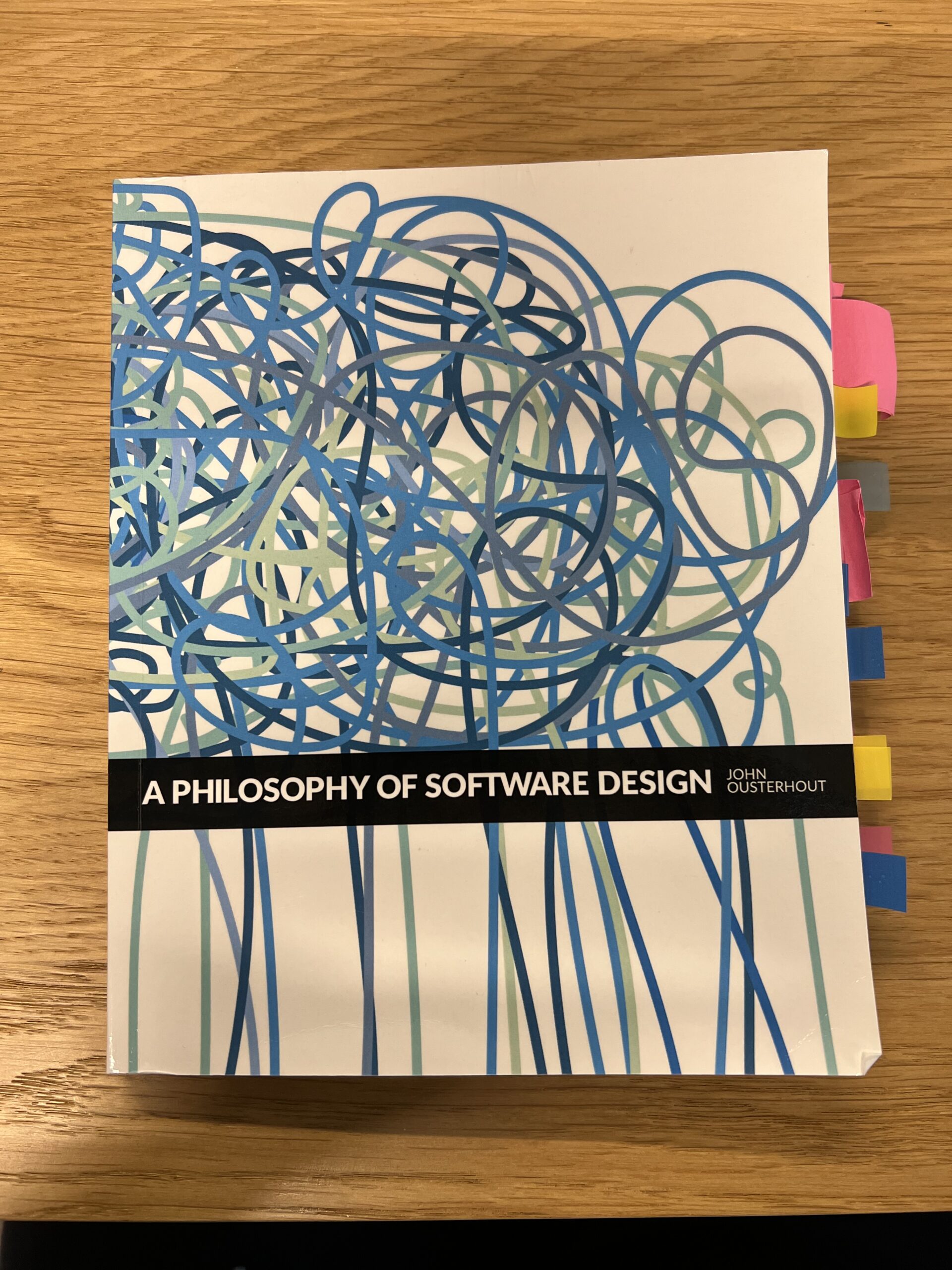
Book Review – A Philosophy of Software Design by John Ousterhout
“A Philosophy of Software Design” by John Ousterhout is a short and thought-provoking book about practical software development.
Key Concept
The book starts with a bold claim – the most critical job of a software engineer is to reduce and manage complexity.
Mr. Ousterhout defines complexity as “anything related to the structure of a software system that makes it hard to understand and modify the system.”
This definition serves as a motivating principle for the book. The author explores where complexity comes from and how to reduce it in a series of short chapters, which often include real-world code examples.
Summary
The book starts with identifying the symptoms of complexity:
- The difficulty in making seemingly simple changes to a system.
- Increasing cognitive load – i.e., a developer’s ability to understand a system’s behavior.
- The presence of “Unknown unknowns” – undocumented and non-obvious behavior.
Mr. Ousterhout states that there are two leading causes of complexity in a software system:
- Dependencies – A given piece of code cannot be understood or modified in isolation
- Obscurity – When vital information is not apparent. Obscurity arises due to a need for more consistency in how the code is written and missing documentation.
To reduce complexity, a developer must focus not only on writing correct code (“Tactical Programming”) but also invest time to produce clean designs, and effective comments and fix problems as they arise (“Strategic Programming”).
The book provides several actionable approaches to reducing complexity.
Some highlights:
- Modular design can help encapsulate complexity, freeing developers to focus on one problem at a time. It is more important for a module to have a simple interface than a simple implementation.
- Prevent information leakage between modules and write specialized code that implements specific features (once!).
- Functions (or modules) should be deep – and developers should prioritize sound design over writing short and easy-to-read functions.
- Consider multiple options when faced with a design decision. Exploring non-obvious solutions before implementing them could result in more performant and less complex code.
- Writing comments should be part of the design process, and developers should use comments to describe things that are not obvious from the code.
The book concludes with a discussion of trends in software development, including agile development, test-driven development, and object-oriented programming.
Conclusion
“A Philosophy of Software Design” is an opinionated and focused book. It provides a clear view of the challenges of writing good code, which I found valuable.
Mr. Ousterhout provides actionable advice for novice and experienced developers by focusing on code, comments, and modules.
However, the book is also relatively low-level. The book contains little discussion around system design, distributed systems, or effective communication (outside of good code and effective comments).
While books such as “The Pragmatic Programmer” provide a more rounded approach to software engineering, I admire that Mr. Ousterhout sticks to the core concepts in his book.
Book Review: “Artificial Intelligence – A Guide for Thinking Humans” by Melanie Mitchell

Introduction
Melanie Mitchell’s book “Artificial Intelligence – A Guide for Thinking Humans” is a primer on AI, its history, its applications, and where the author sees it going.
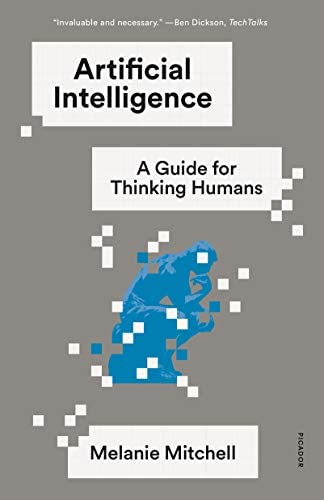
Ms. Mitchell is a scientist and AI researcher who takes a refreshingly skeptical view of the capabilities of today’s machine learning systems. “Artificial Intelligence” has a few technical sections but is written for a general audience. I recommend it for those looking to put the recent advances in AI in the context of the field’s history.
Key Points
“Artificial Intelligence” takes us on a tour of AI – from the mid-20th century, when AI research started in earnest, to the present day. She explains, in straightforward prose, how the different approaches to AI work, including Deep Learning and Machine Learning, based approaches to Natural Language Processing.
Much of the book covers how modern ML-based approaches to image recognition and natural language processing work “under the hood.” The chapters on AlphaZero and the approaches to game-playing AI are also well-written. I enjoyed these more technical sections, but they could be skimmed for those desiring a broad overview of these systems.
This book puts advances in neural networks and Deep Learning in the context of historical approaches to AI. The author argues that while machine learning systems are progressing rapidly, their success is still limited to narrow domains. Moreover, AI systems lack common sense and can be easily fooled by adversarial examples.
Ms. Mitchell’s thesis is that despite advances in machine learning algorithms, the availability of huge amounts of data, and ever-increasing computing power, we remain quite far away from “general purpose Artificial Intelligence.”
She explains the role that metaphor, analogy, and abstraction play in helping us make sense of the world and how what seems trivial can be impossible for AI models to figure out. She also describes the importance of us learning by observing and being present in the environment. While AI can be trained via games and simulation, their lack of embodiment may be a significant hurdle towards building a general-purpose intelligence.
The book explores the ethical and societal implications of AI and its impact on the workforce and economy.
What Is Missing?
“Artificial Intelligence” was published in 2019 – a couple of years before the explosion in interest in Deep Learning triggered due to ChatGPT and other Large Language Models (LLMs). So, this book does not cover the Transformer models and Attention mechanisms that make LLMs so effective. However, these models also suffer from the same brittleness and sensitivity to adversarial training data that Ms. Mitchell describes in her book.
Ms. Mitchell has written a recent paper covering large language models and can be viewed as an extension of “Artificial Intelligence.”
Conclusion
AI will significantly impact my career and those of my peers. Software Engineering, Product Management, and People Management are all “Knowledge Work.” And this field will see significant disruption as ML and AI-based approaches start showing up.
It is easy to get carried away with the hype and excitement. Ms. Mitchell, in her book, proves to be a friendly and rational guide to this massive field. While this book may not cover the most recent advances in the field, it still is a great introduction and primer to Artificial Intelligence. Some parts of the book will make you work, but I still strongly recommend it to those looking for a broader understanding of the field.