Prompting Is All You Need

Agents are supposed to be the future of how we build AI software. I am not so sure.

Prompts, Agents, and Workflows

First, there’s a terminology clarification worth making upfront. What many in the industry call “agents” are actually what Anthropic more precisely defines as “workflows” – predetermined chains of LLM calls orchestrated through fixed code paths.

True agents, by contrast, are autonomous systems that dynamically direct their own processes and tool usage.

Most of what we see deployed today are workflows: decomposing complex tasks into a hierarchy of specialized LLM calls, with routing layers orchestrating the interactions.

In a Workflow, each step maintains its own context, can call specific tools, and handles a narrow slice of the overall problem. These multi-step workflows are powerful abstractions, but they’re not the only way to build sophisticated AI behaviors.

A typical Workflow (from Anthropic)

True autonomous agents? They’re even further from what most applications actually need.

The Hidden Costs of Multi-Step Workflows

LLM workflows come with significant disadvantages that often get glossed over in the excitement of building AI Applications:

Errors compound. Each step in the workflow chain is non-deterministic. When you chain multiple LLM calls together, minor errors or unexpected outputs cascade through the system. You need evaluation frameworks for each step AND the entire workflow.

Latency adds up. Every workflow step means another round trip to an LLM. A simple request that spans three steps results in three sequential API calls, each with its own network and processing time.

Costs pile up. Multiple workflow steps mean multiple API calls, each processing similar context. This could result in significant API costs as the number of tokens goes up.

Predictability suffers. Debugging why a workflow produced a particular output requires tracing through multiple decision points, each with its own probabilistic behavior.

I had to make decisions around which concerns belong together and which should remain separate. I ended up with two LLM calls – the Guardrails Layer and the Main Layer.

The Guardrails Layer operates as a lightweight, independent LLM call. Content safety is a fundamentally different concern from the companion’s behavior. It requires different evaluation criteria, different error handling, and potentially a different model optimized for classification.

The Main Prompt combines three complementary, but separate, layers:

  • Personality Layer: Defines the AI assistant’s identity and communication style (here is the default personality)
  • Context Layer: Determines which user information may be relevant to the current prompt. For example, what books they are currently reading, previous messages in a conversation, etc.
  • Directives Layer: Tool-use and output-formatting instructions for the prompt. I use a configuration-driven approach that lets you add multiple directives to a single prompt. You can think of Directives as sub-layers that drive the behavior and output of the prompt.
Building a comprehensive system prompt

These three layers share a coherent purpose – they all contribute to HOW the AI companion responds. They get composed programmatically into a single system prompt.

This approach means just two LLM calls instead of a chain of four or five workflow steps. More importantly, each call has a clear, singular purpose.

With prompt caching, this architecture becomes incredibly efficient. That comprehensive system prompt costs almost nothing after the first request, and the lightweight guardrails check is minimal overhead.

What about Prompt Engineering?

A lot of prompt engineering thinking is stuck in 2023, when tokens were expensive, context windows were small (4K-8K), and models were less capable.

But look at what’s available in November 2025: Haiku 4.5 is a fast, cheap model with phenomenal capabilities. It handles tool use, follows complex instructions, and, with prompt caching, makes repeated calls incredibly efficient.

By combining software engineering principles with modern LLM capabilities, the approach I am taking offers:

  • Reduced latency: One LLM call instead of multiple calls
  • Lower costs: Reduced total number of tokens with prompt caching
  • Extensibility: I can swap out the Agent Personality, or layer directives, or change the way I build the context
  • Fewer errors (in aggregate): Just two prompts in the chain, with the Guardrails prompt being fairly deterministic

Where Workflows and Agents Fit In

Let me be clear about what I’m arguing against and what I’m not.

Workflows (predetermined chains of LLM calls) have their place. When you genuinely need different specialized processing steps that can’t be combined – say, translating content, then checking it for cultural appropriateness with other models – a workflow makes sense. But these cases are less common than current practice suggests.

True agents (autonomous systems that decide their own next steps) are valuable for tasks that are not fully specified or might have multiple solutions. Complex research tasks, multi-step debugging sessions or adaptive planning scenarios may be suitable for truly agentic approaches.

My observation is that the complex multi-step workflows or unpredictable “agentic” systems achieve what a well-structured prompt with sound context engineering can easily and cheaply handle. They’re adding architectural complexity and risk without significant benefits.

Moving Forward

The rapid evolution and improvement in LLM capabilities mean our architectural patterns need to evolve, too. What made sense with smaller models and tiny context windows doesn’t necessarily apply today.

My suggestion: start with prompt engineering. Apply software engineering principles. Push it to its limits. Layer your concerns appropriately. Use the model’s native capabilities.

You might be surprised how far a well-architected prompt system can take you.

Sometimes, prompting really is all you need.

Negotiating with a strange peer ..

An under-appreciated facet of LLMs is just how *weird* they are.

Claude, ChatGPT, and pretty much every other application built on top of an LLM have a system prompt. This is a set of instructions that drives the application’s behavior. The good folks at Anthropic recently released the system prompts used for the Claude application (see link below).

Anyone building applications on top of LLMs should examine Claude’s system prompts to understand how “prompt engineering” is done in production.

Take this example:

“Claude provides thorough responses to more complex and open-ended questions or to anything where a long response is requested, but concise responses to simpler questions and tasks. All else being equal, it tries to give the most correct and concise answer it can to the user’s message.”

This is how “programming” in an LLM-powered world works. As a recovering Java programmer, this blows my mind 🤯.

Here is the thing—we are going to see wild new software experiences built on top of LLMs in the coming years.

But this will only happen once software engineers shed decades of iterative or declarative approaches to “programming” and learn how to work with LLMs.

A paradigm shift will be required to move us beyond the idea that LLMs are just another fancy API that we can integrate into existing applications.

We call working with LLMs “prompt engineering,” but there isn’t much engineering here. This art or skill should probably be called “LLM Whispering” or “LLM Negotiation.” Because what we will be doing isn’t engineering so much as negotiating or working with a very strange peer.

Melanie Mitchell on the Turing Test

From “The Turing test and our shifting conceptions of intelligence” by Melanie Mitchell.

In her insightful piece, “The Turing Test and our shifting conceptions of intelligence,” Melanie Mitchell challenges the traditional view of the Turing Test as a valid measure of intelligence. She argues that while the test may indicate a machine’s ability to mimic human conversation, it fails to assess deeper cognitive abilities, as demonstrated by the limitations of large language models (LLMs) in reasoning tasks. This prompts us to reconsider what it truly means for a machine to think, moving beyond mere mimicry to a more nuanced understanding of intelligence.

Our understanding of intelligence may be shifting beyond what Turing initially imagined.

From the article:

On why Turing initially proposed the Turing Test

Turing’s point was that if a computer seems indistinguishable from a human (aside from its appearance and other physical characteristics), why shouldn’t we consider it to be a thinking entity? Why should we restrict “thinking” status only to humans (or more generally, entities made of biological cells)? As the computer scientist Scott Aaronson described it, Turing’s proposal is “a plea against meat chauvinism.”

A common criticism of the Turing Test as a measure of AI capability

Because its focus is on fooling humans rather than on more directly testing intelligence, many AI researchers have long dismissed the Turing Test as a distraction, a test “not for AI to pass, but for humans to fail.”

Smallville, Agent Based Modeling, and Capital Markets

Google and Stanford cooked up something intriguing—a virtual village called Smallville, populated by agents running on the #ChatGPT API.

The researchers witnessed interesting emergent behavior, from coordination and communication to downright adorable interactions among the village’s wholesome residents.

Smallville even comes with cute graphics. But beyond the little sprites organizing Valentine’s Parties (yes, that’s what happens in Smallville): this experiment made me think of my time, a long time ago and in a City far away, in Capital Markets.

Smallville (courtesy Ars Technica)

Sidebar

Derivatives are a vast market. And derivatives, like options, are priced using a somewhat arcane mathematical field called Stochastic Calculus – the Black-Scholes equation being a famous example.

The underlying assumption is that markets behave randomly, and Stochastic Calculus provides a way of modeling this behavior. But – this approach can have problems. Even the famous creators of the Black-Scholes equation spectacularly blew up their fund LTCM.


Enter Agent Based Modelling (ABM): a nifty but niche approach that relies on simulating the behavior of market participants via Agents. The idea is that these simulations provide a better insight into how the market may evolve under different conditions.

Smallville shows us that LLM-driven agents are a possibility. Is it a stretch to envision specialized LLMs, trained on financial data, being used in ABM to predict how a particularly temperamental market might behave?

If you are a quantitative analyst on a sell-side firm looking to market-make a particularly exotic derivative, an LLM-powered approach may be viable. Or at least less boring than reaching for the Stochastic Calculus textbook.

The future might find traders armed with their own simulated worlds to forecast the price of, oh, let’s say, a derivative on the price of an exotic tulip of a non-fungible JPEG of a smoking Ape.. who knows?

PS – The painting is called “The Copenhagen Stock Exchange” by P.S. Krøyer. You can see why an agent-based approach to simulating capital markets is a .. possibility..

The Future is Here..

It’s just not very evenly distributed ..

This thought-provoking quote by William Gibson has been on my mind recently. The frantic pace of AI development contrasts sharply with the casual indifference of friends and family who do not care about cutting-edge technology.

Most people outside the tech community may have heard about ChatGPT, LLMs, or other “autonomous” technology in passing.

However, we will increasingly see these worlds intersect. Take, for example, this amusing video of a San Francisco police officer attempting to reason with a wayward Waymo car.

The cop steps before the slow-moving vehicle, commanding it to stop and stay like an errant puppy. He then lights a flare in front of the car, hoping the smoke would make it stop.

The video is funny but is also a cautionary tale of the types of issues that we will face when introducing autonomous agents to the broader public.

Just like the bewildered cop, we will have to deal with users who do not understand the capabilities and limitations of new technology.

Designing effective User Interfaces and Experiences for these complex new technologies will be critical to broad and safe adoption.

Generative Models and the “Grey Goo Problem”

Generative AI models may be causing a “Grey Goo” problem with art, publishing, and user-generated content. 

Thomas Jane encounters the Protomolecule in The Expanse

The Grey Goo Problem is a thought experiment where self-replicating nano-robots consume all available resources leading to a catastrophic scenario. This scenario is a popular science fiction trope (see comments).

Several publishers and user-generated content sites like StackOverflow have been impacted by a flood of AI-generated content in the last few months. Clarkesworld, a science fiction magazine, stopped accepting submissions last week. Even LinkedIn is overrun by ChatGPT-generated “thought leadership.” 

Tools like ChatGPT need high-quality training data to generate good results. They collect training data by scraping the Internet. You can see the issue here, can’t you? 

The Grey Goo scenario is managed through containment and quarantine in science fiction. For example, in The Expanse series (see image), containing the “Proto-Molecule” is a crucial plot element. 

The need to contain and quarantine Generative AI will result in more paywalls, subscriptions, and gated content. Crypto may even find its calling in guaranteeing the authenticity of online content. 

I fear that the Open Internet that made ChatGPT possible will be crippled by the actions of ChatGPT and its cousins.

Google, Microsoft and the Search Wars

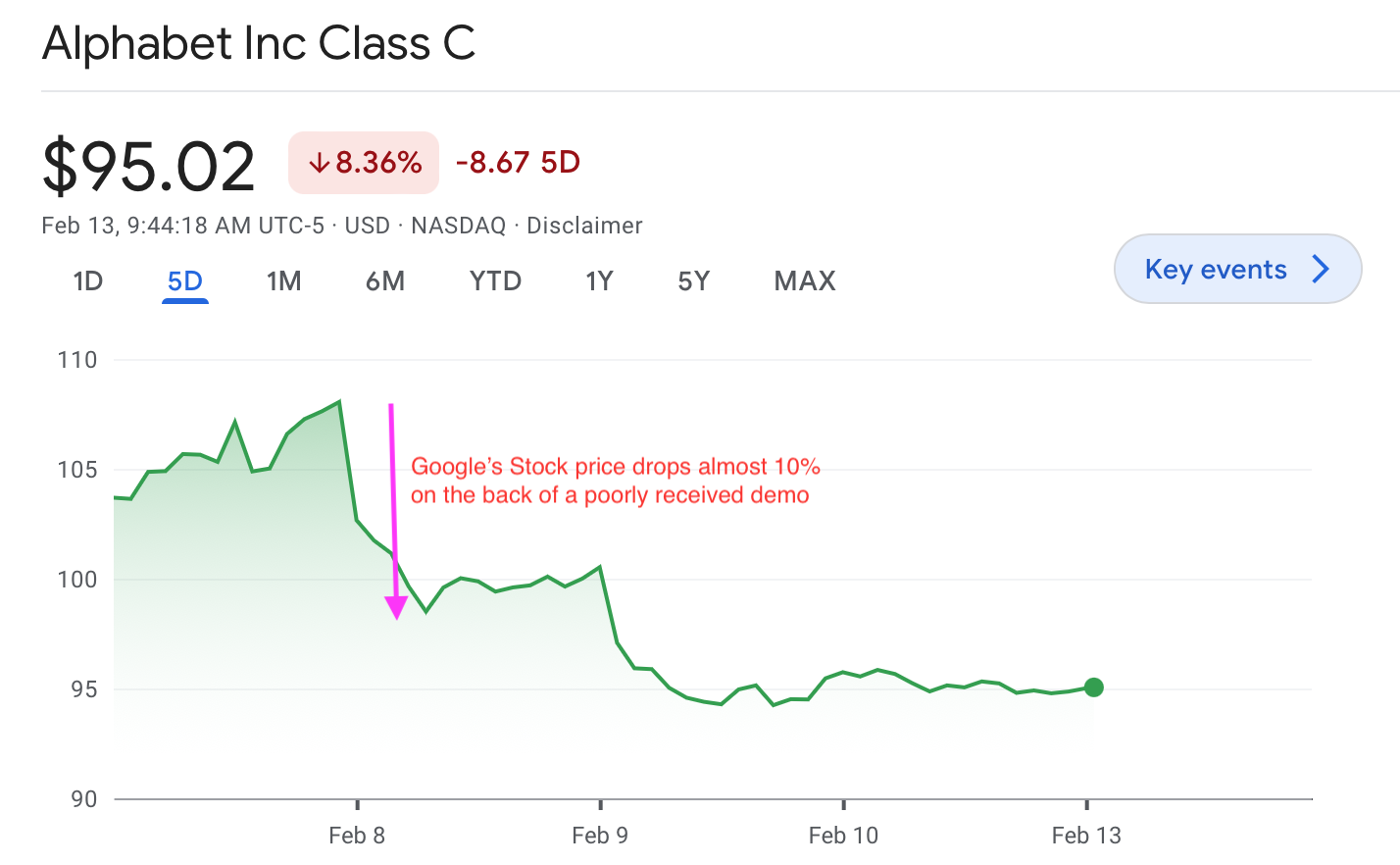
A demo cost Google’s shareholders $100bn dollars last week. Why?

Google’s Share Price after the Bard event

Google has dominated search and online advertising for the last twenty years. And yet, it seems badly shaken by Microsoft’s moves to include a ChatGPT-like model in Bing search results. 

Why is this a threat to Google?

1️⃣ Advertising: Google’s revenues are driven by the advertisements it displays next to search results. The integration of language models allows users to get answers – removing the need to navigate to websites or view ads for a significant subset of queries.

2️⃣ Capital Expenditure: Search queries on Google cost around $0.01 (see link in the comments for some analysis). Integrating an LLM like ChatGPT *could* cost an additional 4/10th of a cent per query since the costs of training and inference are high. Even with optimization, integrating LLMs into Google search will increase costs in running search queries. According to some estimates, this directly impacts the bottom line to almost $40bn. 

3️⃣ Microsoft’s Position: Bing (and, more broadly, search) represents a small portion of Microsoft’s total revenues. Microsoft can afford to make search expensive and disrupt Google’s near-monopoly. Indeed Satya Nadella, in his interviews last week, said as much (see comments). 

4️⃣ Google’s Cautious AI Strategy: Google remains a pioneer in AI research. After all, the “T” in GPT stands for Transformer – a type of ML model created at Google! Google’s strategy has to sprinkle AI in products such as Assistant, Gmail, Google Docs, etc. While they probably have sophisticated LLMs (see LaMDA, for example) on hand, Google seems to have held off releasing an AI-first product to avoid disrupting their search monopoly. 

5️⃣ Curse of the demo: Google’s AI presentation seemed rushed and a clear reaction to Microsoft’s moves. LLMs are known to generate inaccurate results, but they didn’t catch a seemingly obvious error made by their BARD LLM in a recorded video. This further reinforced the market sentiment that Google seems to have lost its way.

References and Further Reading

Explaining Reinforcement Learning with Human Feedback with Star Trek

Microsoft announced today that it will include results from a Large Language Model based on GPT-3 in Bing results. They will also release a new version of the Edge browser that will include a ChatGPT-like bot. 

GPT-3 has been around for almost two years. What has caused this sudden leap forward in the capabilities of Large Language Models 🤔?

The answer is – *Reinforcement Learning From Human Feedback* or RLHF. 

By combining the capabilities of a large language model with those of another model trained on the end-users preferences, we end up with the uncannily accurate results that ChatGPT seems to produce.

Ok – but how does RLHF work? Let me try and explain with a (ridiculous) analogy. 

In the Star Trek series, the Replicator is a device that can produce pretty much anything on demand. 

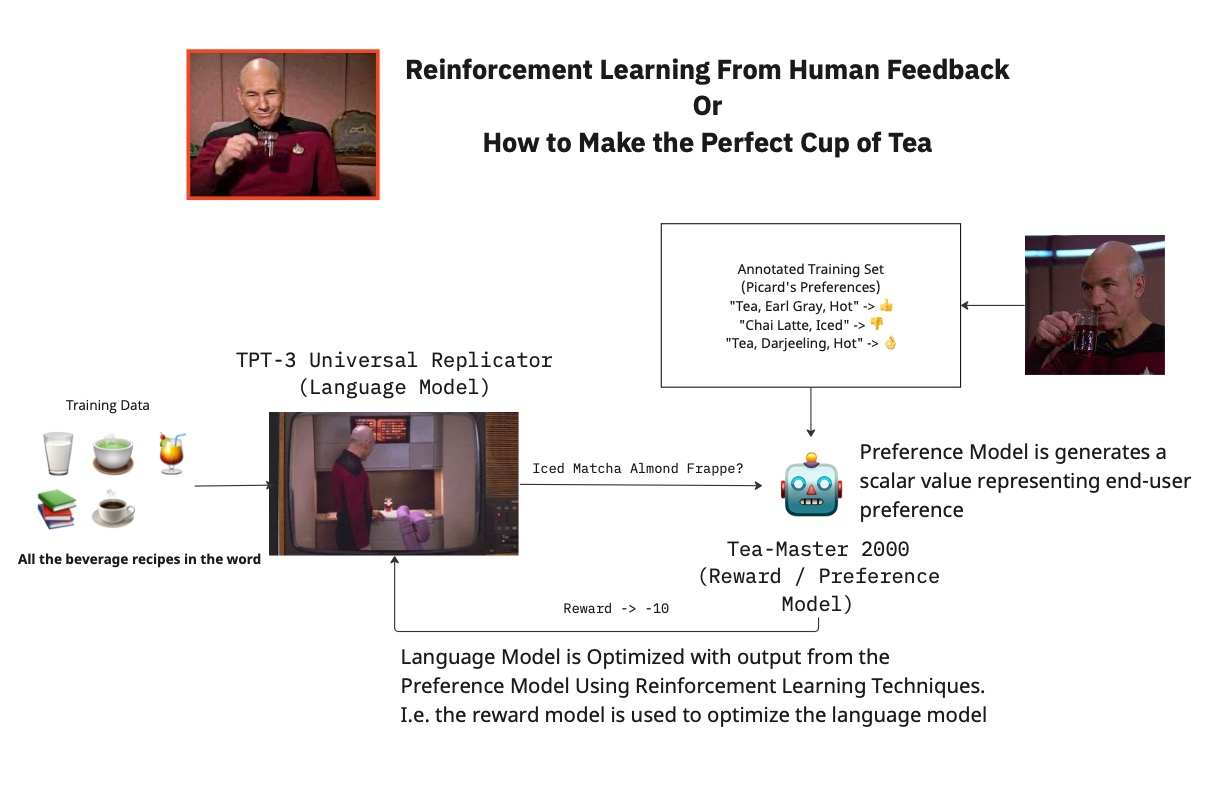
When Captain Picard says, “Tea, Earl Grey, Hot!” it produces the perfect cup of tea. But how might you train a Replicator? With RLHF, of course!

Explaining RLHF

Let’s see how:

1. Feed the Replicator with all the beverage recipes in the known universe.

2. Train it to try and predict what a recipe would be when given a prompt. I.e. when a user says “Tea, Earl Gray, Hot!” – it should be able to predict what goes into the beverage.

3. Train *another* model – let’s call it the “Tea Master 2000” with Captain Picard’s preferences. 

4. When the Replicator generates a beverage, the Tea Master responds with a score. +10 for a perfect cup of tea, -10 for mediocre swill. 

5. We now use Reinforcement Learning (RL) to optimize the Replicator to get a perfect ten score. 

6. After much optimization, the Replicator can generate the perfect cup of tea – tuned to Captain Picard’s preferences.

If you substitute the Replicator with an LLM like GPT-3, and substitute the Tea Master with another ML model called the *Preference* model, then you have seen RLHF in action! 

It is a lot more complicated, but I will take any opportunity to generate Star Trek TNG-themed content 🖖.

Further Reading

Hugging Face has a fantastic blog post explaining RLHF in detail: https://huggingface.co/blog/rlhf

For those more visually inclined, Hugging Face also has a YouTube video about RLHF: https://www.youtube.com/live/2MBJOuVq380?feature=share

Anthropic AI has a paper that goes into a lot of detail on how they use RLHF to train their AI Assistant: https://arxiv.org/abs/2204.05862

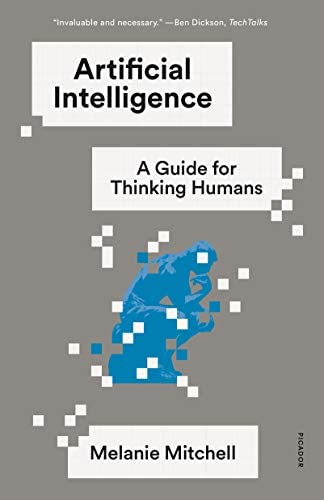
Book Review: “Artificial Intelligence – A Guide for Thinking Humans” by Melanie Mitchell

Artificial Intelligence – A Guide For Thinking Humans

Introduction

Melanie Mitchell’s book “Artificial Intelligence – A Guide for Thinking Humans” is a primer on AI, its history, its applications, and where the author sees it going. 

Ms. Mitchell is a scientist and AI researcher who takes a refreshingly skeptical view of the capabilities of today’s machine learning systems. “Artificial Intelligence” has a few technical sections but is written for a general audience. I recommend it for those looking to put the recent advances in AI in the context of the field’s history.

Key Points

“Artificial Intelligence” takes us on a tour of AI – from the mid-20th century, when AI research started in earnest, to the present day. She explains, in straightforward prose, how the different approaches to AI work, including Deep Learning and Machine Learning, based approaches to Natural Language Processing. 

Much of the book covers how modern ML-based approaches to image recognition and natural language processing work “under the hood.” The chapters on AlphaZero and the approaches to game-playing AI are also well-written. I enjoyed these more technical sections, but they could be skimmed for those desiring a broad overview of these systems. 

This book puts advances in neural networks and Deep Learning in the context of historical approaches to AI. The author argues that while machine learning systems are progressing rapidly, their success is still limited to narrow domains. Moreover, AI systems lack common sense and can be easily fooled by adversarial examples. 

Ms. Mitchell’s thesis is that despite advances in machine learning algorithms, the availability of huge amounts of data, and ever-increasing computing power, we remain quite far away from “general purpose Artificial Intelligence.” 

She explains the role that metaphor, analogy, and abstraction play in helping us make sense of the world and how what seems trivial can be impossible for AI models to figure out. She also describes the importance of us learning by observing and being present in the environment. While AI can be trained via games and simulation, their lack of embodiment may be a significant hurdle towards building a general-purpose intelligence.

The book explores the ethical and societal implications of AI and its impact on the workforce and economy.

What Is Missing?

“Artificial Intelligence” was published in 2019 – a couple of years before the explosion in interest in Deep Learning triggered due to ChatGPT and other Large Language Models (LLMs). So, this book does not cover the Transformer models and Attention mechanisms that make LLMs so effective. However, these models also suffer from the same brittleness and sensitivity to adversarial training data that Ms. Mitchell describes in her book. 

Ms. Mitchell has written a recent paper covering large language models and can be viewed as an extension of “Artificial Intelligence.”

Conclusion

AI will significantly impact my career and those of my peers. Software Engineering, Product Management, and People Management are all “Knowledge Work.” And this field will see significant disruption as ML and AI-based approaches start showing up. 

It is easy to get carried away with the hype and excitement. Ms. Mitchell, in her book, proves to be a friendly and rational guide to this massive field. While this book may not cover the most recent advances in the field, it still is a great introduction and primer to Artificial Intelligence. Some parts of the book will make you work, but I still strongly recommend it to those looking for a broader understanding of the field.

Big Tech’s Layoffs, AI, and the Closing of the Productivity Gap

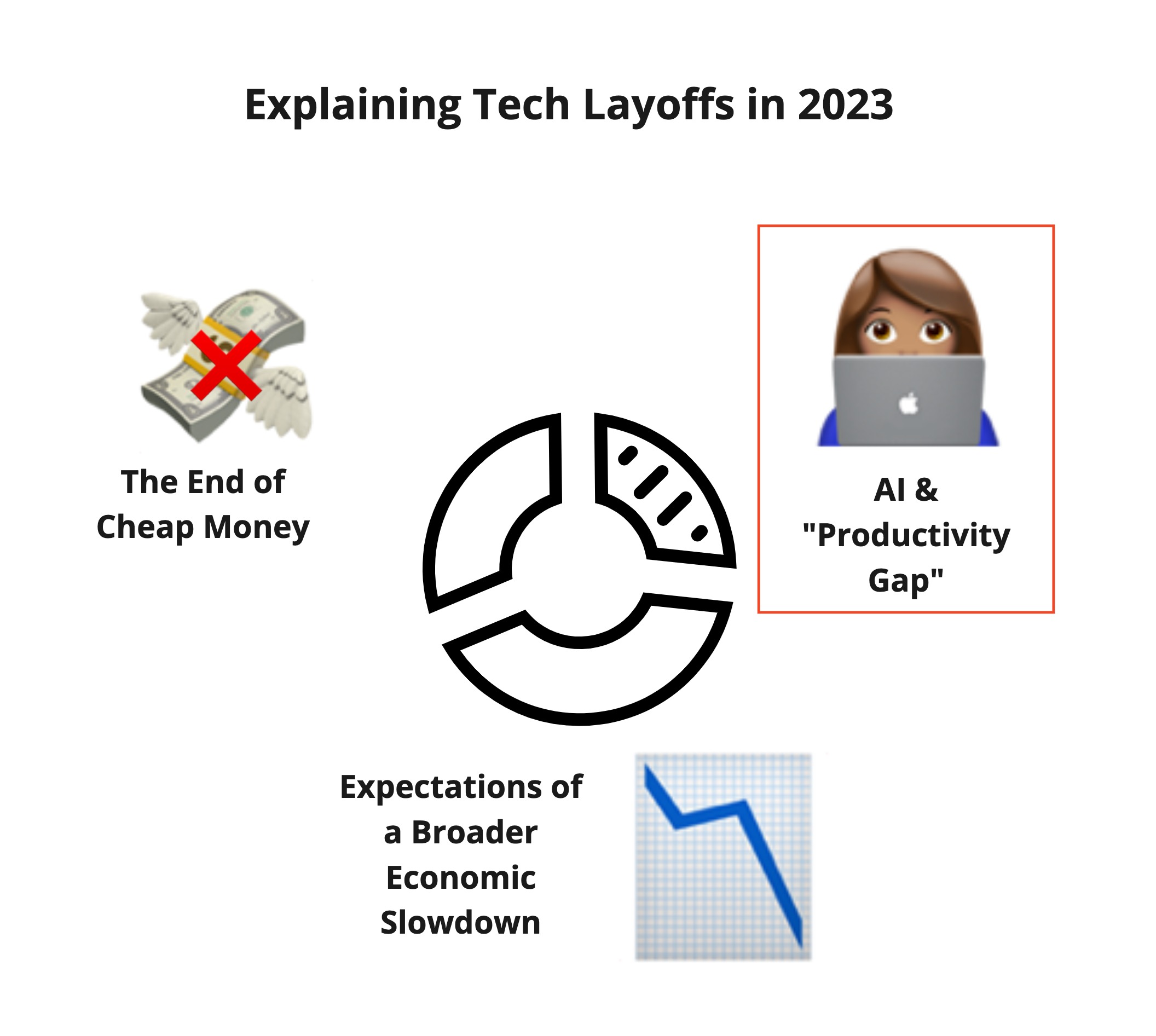
Big Tech has let go of thousands of workers in the last couple of months. In addition to the end of the era of cheap money and a broader economic slowdown, this story may have another angle.

This is the impact of AI and the possible closing of the “Productivity Gap.” 

The Productivity Gap is a phenomenon where workers’ output, especially in developing countries, has been growing slower than expected. The shift to cloud computing and SaaS business models in the mid-2010s led to an explosion in both the valuations of technology companies and increases in the productivity of individual engineers and teams. A small startup could spin up and scale a business faster than ever. 

Fast forward to the mid-2020s, and suddenly cloud computing is a commodity. Innovative Frameworks from the last decade, like React, Spring, and others, are bloated and complex. 

For the last few years, companies like Meta, Alphabet, and Microsoft could hedge their bets and grow their teams because they were less likely to become disrupted by a small startup. Hoarding talent and doing “acqui-hires” was a feasible strategy.

Explaining the Tech Layoffs

Now there is once more a disruptive technology on the horizon. Generative AI Models are making giant leaps – a small team of ML-native programmers could build something that could blow incumbent services out of the water. 

Alphabet’s panic over OpenAI’s ChatGPT is a case in point. Suddenly it doesn’t make sense to hoard talent to work on a platform that is about to be irrelevant. 

AI-enabled software and infrastructure could close the productivity gap and fuel the rise of disruptive startups. 

The incumbents are then cutting costs and preparing themselves for the next round of disruption by making significant investments in AI. 

It no longer makes sense to hoard programmers when the entire industry could undergo a paradigm shift similar to that brought about by Cloud Computing 15 years ago.

The brutal layoffs we have seen in the last three months could be the result.