My grandfather claimed that there was a magical cave under his house, full of treasure. We just needed to dig through the floor, but my grandmother wouldn’t allow it because of the mess.
I grew up in a storytelling culture. My earliest memories are of lying on the roof of my grandparents’ house, listening to him tell us about his friend who was secretly a princess. If you woke up early enough, you could find her riding a golden chariot through the streets before dawn. The stories themselves have faded, but I remember how they made me feel.
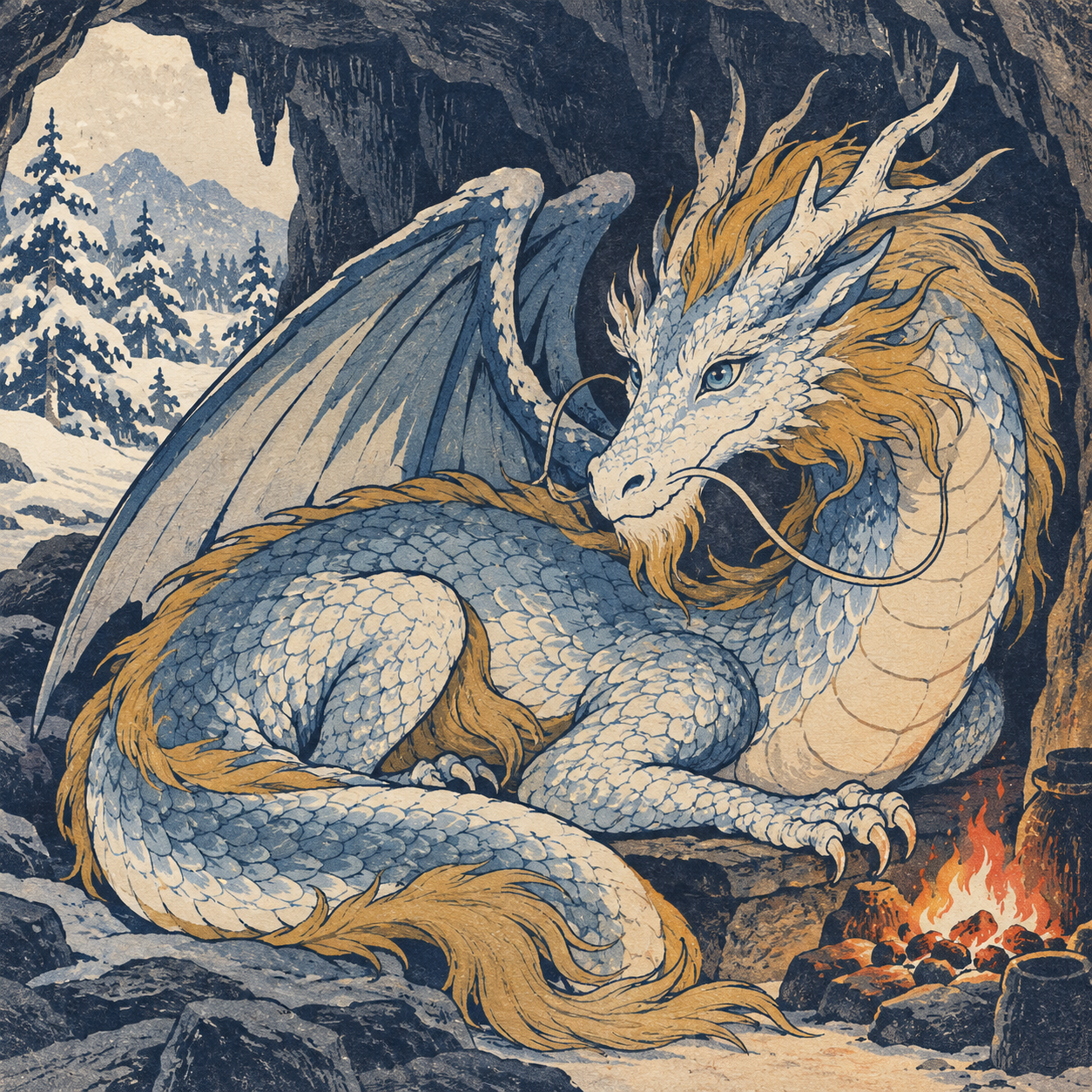
This weekend I built a small website for the stories my daughters and I tell at bedtime. The ones on the site are about Miyuki, an eight-year-old who lives with her father in a coastal village. These stories change in the telling. Sometimes the dragon has a golden mane and sometimes it breathes fire, but Miyuki’s wonder at meeting it in the cave is always the same. This site was built for an audience of two.
The Dragon – with a golden mane this time
ChatGPT transcribed the stories from voice notes I recorded at bedtime and helped me turn them into readable prose. My daughters and I imagined the animals and an AI tool generated the illustrations. Claude helped me build and publish the site. The site took a couple of days. The stories took two years.
Without AI, these stories would have stayed where my grandfather’s did, on the rooftop on a late summer night, or in my daughters’ memories.
There is a lot of argument right now about the ethics of AI. Is AI-generated art stealing? Is it all slop? For me, the art was in the telling of the stories. In the bedtime routines of a four-year-old, a six-year-old and their middle-aged dad. The AI was the scribe and the illustrator, but the stories are our own.
All the handwringing leaves something out. A tired dad with two young children can now capture what would otherwise be lost, and give it a shape that lasts.
Oral storytelling has its own beauty. Nothing is fixed, and eventually the teller is gone. Maybe pinning these stories to a website is the wrong instinct. But I had children late. If they do the same, I will be well into my seventies before their children are ready for the dragon in the cave.
This way at least, they might get to know their whimsical old grandad a little.
This letter comes to you from January, 2026. I know 2024 was rough, and you are wondering about what comes next. I can tell you. Some of it will help. Some won’t. But you should know.
On Parenting
Being a father will continue to be the hardest and the most rewarding project you take on. The highs will be high: the 5-year-old starting kindergarten, working on her reading, her delight in tales from the Indian Epics – again and again. The 3-year-old starting pre-k and developing an absolutely delightful (and maybe slightly unhinged?) sense of humor.
The lows will involve too many sleepless nights, epic meltdowns, and becoming adept at catching puke with your bare hands so you don’t have to change the sheets for the fourth time that night.
You will complain about how they insist on climbing into bed with you in the early hours.
But, when they don’t, you will wake with a start and tiptoe into their room to make sure they’re okay.
There will be dancing. K-POP. So much K-POP that you will find yourself humming it while walking the dog or waiting to join a Zoom call. Sometimes you will find yourself watching YouTube videos analysing songs from K-POP Demon Hunter and wondering if they will make a sequel. I don’t know yet.
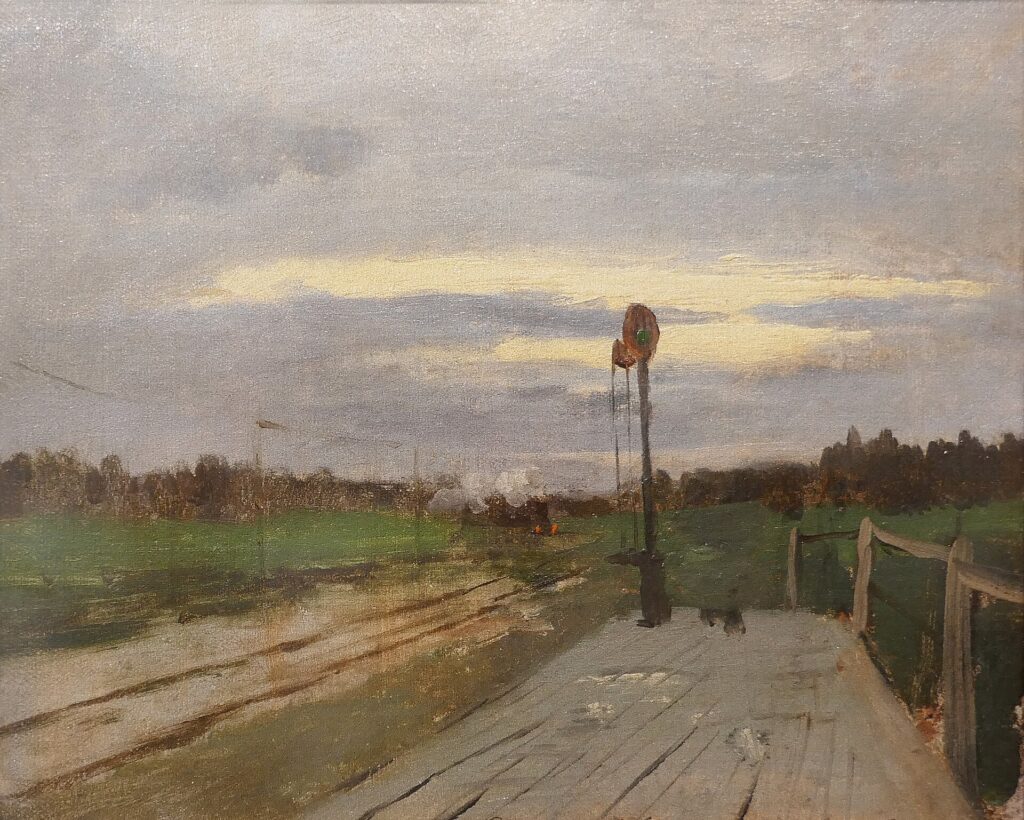
(Image: Petite gare by Isaac Levitan. Wikimedia Commons)
On Grief
Another year will pass with your father gone. The pain will sometimes recede to a background hum and sometimes it will come roaring back.
Walking into your parents’ house will still be difficult. You’ll wait to hear him call out from his study to come look at something. Wait for the monosyllabic text asking if you’re coming for dinner that night.
Every time you look in the mirror you will see more of him reflected back. The tilt of the head. The slight pout. His impatience will show up when working with the 5-year-old on writing practice. His whimsy when making silly jokes with the 3-year-old.
The grief will settle like sediment at the bottom of a pond. Sometimes it will be disturbed: a photo that surfaces on your phone, a handwritten card found while tidying your office.
Let it stir and let it settle. It’s a part of you now.
On Love
2025 marks fifteen years of marriage. Adventure, adversity, and now domesticity.
Things will be difficult. Having a 3 and 5-year-old makes time together reliant on the kindness and generosity of loved ones. You will make the most of those moments: a short weekend away for a wedding, a few days spent eating out and making inappropriate jokes, the regrettably few nights watching TV under the covers.
One night up in the hills of West Virginia. Looking at the fire. Drinking bourbon. Feeling like twenty-somethings again. It was only one night, but enough to remind you of what it was and what it will be. One day.
There will be arguments, clenched jaws, silent shrugs. There will be reconciliation, often commiseration over what your little tyrants have put you through. Work stress, travel, adjusting schedules, waving at each other’s planes as you cross paths at Dulles.
You will finish the year strong if tired. Your wife more beautiful than ever. You a little more haggard.
On Meaning
You will spend many evenings in a dark room waiting for your children to fall asleep. Answering for the fifth time that morning time will be in ten hours. Fighting the sentimental inner parent who wants to hold his daughter’s hand every night until she drifts off.
Those dark hours are also when you think and wonder.
You will spend hours thinking about whether you will have a job in the new year and what that job will look like. You will fret about your responsibilities to your peers, your teams, your clients. Wrestle with the importance of process versus the value of output.
You will use the same technology that threatens to upend everything. The foundation models. You’ll use them to build tools and bring ideas to life.
Oscillating between dread, wonder, and the defiance of knowing that if you can think it, you can build it.
And underneath it all, the questions that don’t resolve: What does it mean to work when twenty years of hard-won knowledge can be summoned with a prompt? What world will your children inherit? Post-scarcity utopia or hyper-capitalist hellscape where all power and wealth accrues to capital and to compute?
You will wonder about your decision to raise your daughters in a country turning from kindness to cruelty, from embracing diversity to strident ethno-nationalism. You will wonder if they will embrace their Indian heritage or find it more expedient to lean into their ethnic ambivalence.
Those won’t be fun thoughts.
On Stillness
After all the hours spent working and reading and fretting, it will be the quiet moments that matter.
Long walks with your not-very-smart dog. Waiting for the coffee maker to stop bubbling before the first 6am call. Moments when the house is quiet, the mind is still and the body is calm.
Treat each moment like a piece of masonry, building a wall against the coming chaos.
Lean into those moments. Shelter against the storm.
In chemistry, activation energy is the minimum energy required to start a reaction. It’s the barrier between potential and action, between “I could” and “I did.”
This year, AI collapsed that barrier for me.
As foundation models became better, and the tools built on top of them became more useful, the gap between having an idea and acting on it shrank to almost nothing. And for someone whose natural disposition is to try things, to experiment, to see what happens, this has been transformative. I have embraced using AI for work and play and for much else.
Image generated using Gemini Pro
From Thought to Artifact
I’ve written more consistently this year than ever before.
For many years, I used to maintain a list of ideas that I wanted to explore. Bookmarked sites, academic papers, and spicy social media takes. These ideas often were just abandoned or ignored until I forgot why I wrote them down in the first place.
Now, the time between having an idea, doing the research, writing an outline and then publishing it online has shrunk significantly because of AI. I use skills, deep research agents, and a set of prompts that have let me express myself faster and more coherently than ever before.
My recent post “The Same Window For Everything” exists because I noticed something interesting while reading Kiran Desai, opened Claude to think it through, and found myself with the skeleton of an essay. A year ago, that observation might have stayed in my head, filed away with all the other thoughts that never quite made it to the page.
There’s a passion project I’ve been building, a reading companion I’ll be launching soon. It exists because, in 2025, the distance from “what if I built this?” to “let me try” became trivially small. Just like my writing ideas, I have a huge list of side projects and experiments that I wanted to try but never got off the ground. This year, I did.
But, it’s not all serious stuff! I vibe-coded (built quickly with AI assistance) a tool to help me journal regularly. I use AI to help plan dinner for my kids. I have setup my phone so it launches ChatGPT in “search mode” at the press of a button. And, I ask it all kinds of questions! From dealing with my dog’s flatulence to figuring out why the minivan doors won’t open. I now look up things where before I would have just shrugged and moved on.
I have a different relationship now with making things; one where the cost of trying something has dropped low enough that I actually try it.
The Professional Stakes
Looking up recipes for spaghetti carbonara is all well and good, but AI has had a significant impact on my work as well.
At Jeavio, we’ve taken on more ambitious, outcome-oriented projects. Internal initiatives I sponsor, like our campus programs, have become more ambitious and aggressive because I believe we can get them done. That belief comes from now having enough experience with using AI tools to be confident on what my teams can and should be able to deliver.
We ran a company-wide hackathon late last year and a product-focused one in 2025. The hackathons shifted how Jeavio thinks about and uses AI tooling. They encouraged experimentation and built collective confidence about what capabilities these tools could unlock.
It’s not all fun and cheap inference though. Some projects have been challenging. We’re working at the frontier of what’s possible, and frontiers can be uncomfortable places.
But my risk appetite has increased. I understand the tools better now. I know what Cursor and Claude Code can do and, equally important, where they fall short. I have a clearer understanding of what guardrails should be in place and how to evaluate the performance of inherently probabilistic systems. That understanding translates into confidence: confidence to take on projects with ambiguity, and confidence to deliver clearer projects faster and more predictably.
The throughline is the same as the personal examples: lower activation energy. Faster exploration, quicker iteration, more willingness to try things that might not work than ever before. For my work at Jeavio, this is an energizing change.
Cyborgs and Foxes
Two frameworks have helped me make sense of what’s changed.
Ethan Mollick, in his research on AI and knowledge work, distinguishes between Centaurs and Cyborgs. Centaurs maintain a clear division of labor between human and machine, handing off discrete tasks to AI. Cyborgs blend the two. As Mollick puts it:
“Cyborgs don’t just delegate tasks; they intertwine their efforts with AI, moving back and forth over the jagged frontier.”
I’ve become a Cyborg.
AI is woven into how I think, write, and build. When I’m reading and want to explore an idea, I open Claude. When I’m coding and hit a wall, I think through the problem with an AI collaborator. The boundaries between what is truly my work and what is AI-mediated have become somewhat meaningless.
The second framework comes from David Epstein’s book Range: Why Generalists Triumph in a Specialized World. Drawing on Isaiah Berlin’s famous distinction and Philip Tetlock’s research on forecasting, Epstein contrasts hedgehogs, who know one big thing deeply, with foxes, who know many things and integrate broadly.
Hedgehogs thrive in stable, rule-bound environments. Foxes thrive in ambiguous, rapidly-changing ones. As Epstein writes:
“Foxes see complexity in what others mistake for simple cause and effect. They understand that most cause-and-effect relationships are probabilistic, not deterministic.”
I’ve always been a fox.
Broad curiosity, comfort with ambiguity, a tendency to wander across domains. But being a fox is expensive and risky. Every new domain requires starting from scratch. The activation energy to explore something unfamiliar is high.
AI subsidizes that cost. Becoming a Cyborg helps make my fox-like tendencies viable in ways they weren’t before. I can move into an unfamiliar domain, quickly get oriented, experiment, and learn, all without the friction that used to make such exploration feel indulgent.
These frameworks work on orthogonal dimensions. Cyborg describes how I work. Fox describes who I am. Becoming a Cyborg made me more comfortable leaning into my fox-ness.
Looking Forward
I’m aware this could sound like boosterism. The AI discourse is full of inflated predictions and productivity theater.
So here’s what 2025 has taught me. Becoming a Cyborg works for me. This may not always be true.
Maybe I am just a frog slowly boiling to irrelevance as AI takes away my agency and creativity.
Maybe the AI bubble might burst, and Anthropic and OpenAI will raise prices making vibe-coding a passion project or having a long conversations about literary fiction non-viable.
But until then: the distance between curiosity and creation has collapsed. I intend to exploit that gap.
More experiments. More wacky things. More small wins and instructive failures. The activation energy is low, and I have a lot of ideas. Bring on 2026.