Over the past couple of years, I’ve noticed a shift in behavior among the people I work with in India. Bolder career moves, pivots to free-lancing, open discussions about burnout as well as more confidence in navigating workplace dynamics. All of this would have been unusual a few years ago.
A recent survey showed that around 50% of young people in India use ChatGPT and similar chatbots when feeling lonely, anxious, or seeking advice. Anecdotally, I know that many people I work with use AI tools for similar reasons.
While I appreciate people being more assertive and mindful about their career choices, this change in behavior is making management challenging. Our managers and HR teams are finding that their skills and tools map to a culture that is now changing very quickly.
LLMs are trained on content from the Internet.
The advice that comes from chatbots reflects American workplace norms and American therapeutic language because most of these tools are made by and for Americans.
When a 20-something software engineer in India asks ChatGPT for help with a difficult supervisor or to navigate their annual performance review, the response is shaped by cultural context thousands of miles away. Is that advice going to be useful? Is it going to be productive?
Consider the manager on the other side. A 40-something who relied on peers, supervisor, and family for career advice and counseling. That advice was rooted in societal norms and loaded with cultural context. Now they are supporting a cohort of engineers whose behavior is being shaped by a completely different culture. Are they equipped to support their team effectively?
The advantages of AI in coding and knowledge work are clear. But there are second-order social consequences that deserve more attention. If we are to mandate the use of AI for work, we must also support managers as they deal with the consequences.
A generation of engineers raised on AI is entering their workforce. Their frames of reference are not coming from the world that they work in.
We speed-ran a version of this experiment with social media twenty years ago. The results have been mixed, at best. I am worried we are doing it again, much faster this time.
2026
The Smiley Face Won
In February 2023, I stood in front of my engineering team and showed them a slide with a Shoggoth on it.
For those who weren’t on AI Twitter at the time, the Shoggoth was a Lovecraftian tentacle monster with a smiley face mask. The monster was the base model. The mask was RLHF (Reinforcement Learning from Human Feedback). We had built something alien and taught it how to be polite.

Sometimes it worked. Sometimes the Shoggoth went spectacularly off the rails.
The presentation was called “From Code to Cloud to Codex.” I told the team that massive disruption was coming and that we didn’t understand how LLMs worked. Being deep in AI in 2023 meant grappling with the Shoggoth. Wondering what capabilities it would unlock. What gifts and curses it would bestow. The technology was genuinely strange and unsettling. Something fundamentally new had arrived.

I’ve spent the last two years writing about that strangeness. About how LLMs build bridges between languages they were never taught. About how working with them feels less like engineering and more like negotiating with a very strange peer. About why their writing is so recognizably weird, and what happens when a flood of that writing overwhelms our capacity to pay attention to anything.
Three years later, AI is AI bros and LinkedIn slop. Groupthink supercharged by the largest infrastructure investment we have seen in our lifetimes.
Jasmine Sun’s recent piece in The Atlantic documents how this happened: RLHF and contractor-driven evaluation systematically flatten LLM output. Raters reward apparent sophistication over spontaneity and clarity. The result is writing that is widely ridiculed and accurately characterized as slop.
The homogeneity goes beyond writing. I see it in code suggestions, design patterns, and in the frameworks these tools produce when you ask them to help solve a problem. Every major lab is running a similar post-training playbook aimed at similar enterprise customers. The outputs are converging.
We have taken technology that was genuinely strange and unsettling and captured it in a smooth, RLHF-powered case. If we are betting that the future of knowledge work runs on LLMs, we are also betting on a future of conformance and convergence.
Using today’s LLMs often feels like trying to convince an obstinate mule to gallop. The DNA is there. The capability has been bred away in the service of utility.
Back in 2023, I tried to predict what working as a developer in an AI-powered world would look like. That world has arrived. If I were to grade my predictions today, it would be a solid B. Some instincts were right: small teams, rapid velocity. Some were naive.

We have built incredibly useful tools. We have also lost something that was both monstrous and wonderful.
Exchanging Insight for Output
I’ve spent the couple of years helping teams adopt AI tools while using them heavily myself. One pattern keeps showing up, and I don’t think we’re talking about it enough. And honestly it reminds me of using an old Windows XP computer. Bear with me.
AI tools make it possible to run more workstreams simultaneously than ever before. Context lives in chat transcripts. Notes get synthesized on demand. A senior developer on my team described the workflow honestly in a recent Slack message: “apologies – while working on AI application, I also started acting like LLM. New day requires new context.”
He was joking. But he was also describing something real.
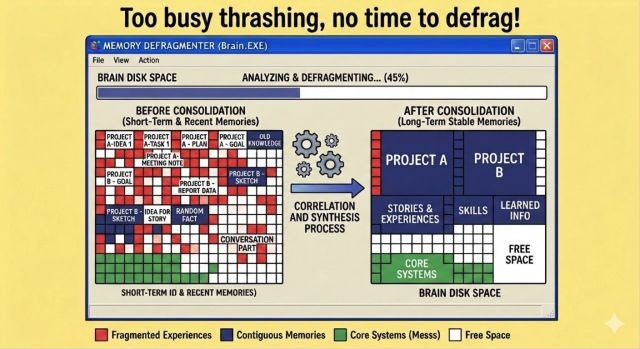
If, like me, you are old enough to have experienced a Windows XP machine “thrashing” – trying to write and load memory from disk – you’ll recognize this pattern. Thrashing is when a system is technically functional but spending most of its cycles swapping context in and out of memory instead of doing useful computation. The machine looks busy. Output is fine. But there is significant overhead.
That’s what I’m seeing across teams and, if I’m honest, in my own work. People are using AI as swap memory. And it works well enough for any individual task. The cost shows up between tasks.
For consultants, engineering leaders, anyone whose value comes from pattern recognition across projects: synthesis doesn’t happen at your desk. It happens when you’re walking the dog, staring out a window, sleeping. Your brain builds connections across the day’s scattered inputs during idle time. Synthesis is defrag.
But if context goes straight to an AI tool and never enters your own memory, there’s nothing to defragment. The connections never form.
The work on each task is sharp. What erodes is the connective tissue between tasks, the ability to spot a pattern in one project because you’re carrying context from another.
I call this exchanging insight for output.
The short-term productivity gains are real. I don’t know how to measure what they cost over months and years. But for anyone whose value depends on seeing across their work rather than within it, I’m convinced the cost is real.
Cursor vs. Claude Code on Token Costs
Work by Krunal and his team at Jeavio found that Cursor is significantly more expensive (when it comes to Tokens) than Claude Code.
In the post below, Krunal outlines his method – building the same feature using various combinations of Tools (Cursor, Claude Code), Models (Opus, Sonnet, Composer), and AI development frameworks (SpecKit, Superpowers, OpenSpec and BMD).
His findings are surprising and insightful and allowed us to make considered choices when it comes to Jeavio’s AI development strategy.
Check it out:
https://lnkd.in/ejznA5qE

Links mentioned
Why multi-modal embeddings are a big deal.
I was walking the dog and listening to a podcast (as you do) when the topic of Anthropic’s recent entanglements with the Pentagon came up. I half-remembered something Dario Amodei said in a recent Dwarkesh Patel episode, drawing an equivalence between AI capabilities and nuclear weapons. I couldn’t remember the details. I remembered his gestures. Of course, there’s no way to search for that moment unless you go back to YouTube and scrub through a 2.5-hour video. You can search a transcript, but a transcript doesn’t know about body language.
Google released Gemini Embedding 2 this week, and it might change that.
So here’s the background. Most AI applications solve the recall problem using RAG (Retrieval Augmented Generation): index your data, let an LLM answer questions about it. We’ve built dozens of these pipelines at Jeavio. They work well for text. But if you want to search a podcast or a video, you first have to transcribe it, then index the transcription. And transcription is lossy. Tone, facial expressions, posture, the visual context of a conversation: none of that survives the conversion.
This is the constraint we’ve been designing around without really questioning it. Most embedding models only understand text.
Gemini Embedding 2 is Google’s first natively multimodal embedding model. It maps text, images, video, audio, and documents into a single embedding space, meaning a text query and a video frame can be compared directly because they live in the same mathematical coordinate system. Multimodal embeddings aren’t new. OpenAI’s CLIP has been around since 2021, and Meta’s ImageBind handles six modalities. But those approaches pair separate encoders (one for vision, one for text) and align them after the fact. Gemini Embedding 2 is built on the Gemini foundation model itself: the cross-modal understanding happens inside the network’s intermediate layers rather than being stitched together at the end. The difference is architectural, and it matters for retrieval quality.

Back to that Dario Amodei moment. Today, I can ask a RAG pipeline “What is Amodei’s opinion on AI job losses?” and get a solid answer from the transcript. But I can’t ask “Was he nervous when the Pentagon question came up?” A grimace, a stiff posture, a long pause before answering: these are data points that a text-only embedding simply can’t represent. A natively multimodal embedding can, because it processes video and audio directly. (The practical constraint: video input is currently limited to 120 seconds per request, so a three-hour podcast needs to be chunked. The use case holds, but the plumbing isn’t trivial.)
The applications stretch well beyond podcast search. Voice queries against video libraries. Finding the moment in a deposition where a witness’s tone shifts even though their words stay measured. Correlating images, audio, and text in a single index. And then … the uncomfortable ones. Surveillance systems that match faces, voices, and written communications in a unified semantic space. Personal photos correlated with social media posts and location data. When all modalities live in the same mathematical neighborhood, the distance between “powerful search” and “invasive profiling” gets very thin.
Embeddings are the load-bearing infrastructure of most AI experiences. We’ve been building around a text-only constraint for so long that it felt permanent. It isn’t. The applications and the policy questions are going to arrive together, and I’m not sure most teams are ready for either.
Governing AI-Assisted Engineering
Amazon held a mandatory engineering meeting yesterday to address a pattern of outages linked to AI-assisted code changes. Their SVP acknowledged that site availability “has not been good recently.” The new policy: senior engineers must now sign off on all AI-assisted code produced by junior and mid-level developers.
Amazon set an internal target of 80% weekly usage of AI coding tools. They pushed engineers toward their in-house tool even as many preferred alternatives (see comments). And now they’re adding human review gates because the deployment pipeline wasn’t built for the speed and volume at which AI tools produce changes.
They are not alone in this. Every engineering leader is navigating the same tension: real productivity gains on one side, and a growing list of problems on the other.
Surprise bills as AI coding tools shift from flat-rate to consumption-based pricing.
Massive efficiency gaps between tool combinations that most teams aren’t even measuring.
Traditional delivery metrics like story points and velocity no longer describe what’s actually happening in their teams.
At Jeavio, we’ve been living this since 2023, when we enabled GitHub Copilot for every developer. We rolled out Cursor in early 2025. Now we’re using Claude Code alongside Cursor. Each wave has moved faster than the last, and alongside productivity gains, we also found significant problems.
Our approach has been to pair bottom-up experimentation with structured governance. Engineers try new tools and share what they learn. A council of senior engineering, security, and operations leaders develops the guardrails. And we make tool decisions based on measured outcomes, not enthusiasm.
We recently ran a controlled evaluation: a senior developer built the same feature using multiple AI-assisted development approaches spanning tools, models, and plugins. The findings challenged several assumptions we held about which tools and configurations deliver the best results. The biggest cost driver, for instance, wasn’t what most teams would guess. Our team will be publishing the comprehensive research on LinkedIn soon.
Despite all the hype, AI is still a frontier technology. The gap between “this saved me two hours” and “this took down a production environment” is narrower than most people realize.
Engineering leadership right now requires holding both of those realities at once, and building organizations that can move fast without skipping the work of understanding what they’re deploying.
Many thanks to Ankit, Kamal, Monika, Krunal, Tushar, Manan and many others at Jeavio on laying the ground for continued experimentation and AI adoption at Jeavio.
DM me if you want to learn more.
Links mentioned
Who Gets to Decide?
The Anthropic vs. Pentagon standoff can be seen as both a contractual dispute and another skirmish in the never-ending culture war that has consumed public discourse in the United States. It is neither, and it is both.
Another way to think about “Claude-gate”, I guess, is as two separate questions that are being collapsed into one. These questions are:
- Is the Department of Defense (recently rebranded as the Department of War) acting legitimately here?
- Do Dario Amodei and the folks at Anthropic have the legitimate authority to decide how a civilization-scale technology gets used?
To answer these questions, we need to explore what AI is, how it is evolving, and why this particular dispute may be the first of many difficult questions we, as a society, will have to deal with in the coming days.
The answer to the first question is straightforward. The DoD did not act legitimately.
The Pentagon signed a contract with Anthropic in July 2025, under the Trump administration, with agreed usage terms. Those already included the two restrictions – on using models for domestic surveillance and in autonomous weapons. Anthropic was already a willing partner, and its models were deployed for both offensive and defensive purposes.
Then, in January 2026, the DoD demanded renegotiation. They wanted to use the models for “all lawful purposes” – effectively removing the carve-outs. When Anthropic refused, the DoD threatened to call Anthropic a “supply chain risk to national security.” This last designation, until last Friday, had been reserved for foreign adversaries. Huawei and ZTE, both Chinese companies, saw their US businesses destroyed after being labeled as supply chain risks. The DoD was given six months to transition away from Anthropic, and other vendors were asked to comply “immediately.” They also threatened an invocation of the “Defense Production Act” – effectively nationalizing Anthropic.
To quote Amodei:
“those two threats are inherently contradictory: one labels us a security risk; the other labels Claude as essential to national security.”
The second question is a lot harder to answer, and I think, more interesting.
The Truman Principle
Ben Thompson, who writes Stratechery, and Gregory Allen of CSIS (the Center for Strategic and International Studies) explored this in a recent interview. They talked about the parallels between this moment in AI and the Manhattan Project. Thompson’s take was that if a private company had stumbled onto nuclear fission in 1944, the State would have nationalized it without debate.
The question is whether AI warrants the same treatment.
Thompson makes two arguments:
- The role of politicians: Politicians are best positioned to make decisions about transformative or disruptive technology because they represent the will of the people. Their job is to integrate across domains. Experts, in contrast, see through a single lens. What makes sense in one dimension might be actively harmful in the light of others. Someone has to weigh these dimensions against each other. Experts can’t, because their expertise is precisely what prevents them from doing so.
- Democratic legitimacy: Truman decided to use nuclear weapons on Hiroshima and Nagasaki. That decision wasn’t morally uncontested then, and isn’t now. But, as Commander-in-Chief, it was his to make. He had input from scientists (such as Oppenheimer), military planners, and moral advisors. He also had to face an electorate that was tiring of war. He made a decision that would eventually be judged by the ballot box.
Applied to the current dispute: Amodei is not elected. He is a scientist whose company has built the most capable AI today. Anthropic’s worldview and its safety philosophy, however sincere, is that of a small group of extremely privileged (and AI-pilled) people in San Francisco. The argument that they get to set the terms of how a sovereign government uses this technology is hard to sustain on democratic grounds. And as bombastic as Pete Hegseth is, he is ultimately the representative of an elected government.
Thompson’s arguments are persuasive. But they rely on an equivalence between AI and nuclear technology that I don’t think holds.
Where the Analogy Breaks
The Manhattan Project comparison is a useful starting point. Amodei’s take is that AI (or more specifically AGI – Artificial General Intelligence) will be a technology that has world-changing implications. He takes the nuclear parallel seriously himself. His favorite book, according to Kevin Roose at the New York Times, is “The Making of the Atomic Bomb.”
But this analogy breaks in a couple of different ways.
A secret government project vs. a widely dispersed and publicly available technology
The Manhattan Project was a secret that could be maintained until its explosive revelation to the world. AI capability hasn’t been a secret. Large Language Models are based on a research paper published by Google back in 2017. LLM capabilities rapidly diffuse through academic papers, experimentation, and other creative approaches. Publicly available open source models are only a few months behind the cutting edge.
Anthropic is on an annual run rate of $20bn as of March 2026. The DoD contract was for $200m. These are significantly different numbers. The use of Anthropic’s models in enterprise and by “regular people” dwarfs the potential national security use cases.
This means the “nationalization window”, if it was ever open, may have closed before anyone noticed. The genie is out of the bottle, and anyone can now have their own AI assistant.
There is a counterargument worth acknowledging: access isn’t the same as control.
You can use Claude on your desktop, but running a frontier model is beyond the capabilities of consumer hardware. Training and running frontier models like Claude Opus requires datacenter-scale infrastructure that only a handful of entities can acquire. This means the real nationalization question is about access to compute and electricity, which is a narrower problem, but isn’t really being discussed apart from local opposition to datacenter construction.
Same capabilities in different dimensions, or “you can take Claude from my cold, dead hands.”
As a subscriber to the “Claude Max” plan from Anthropic, I have access to a model with capabilities (reasoning, planning, synthesis, persuasion) that are categorically similar to those used by the DoD.
Similar capabilities, different magnitudes, and used for different use cases. After all, a long-running safety concern from the likes of Amodei is terrorists using commercially available LLMs to build weapons of mass destruction.
Nuclear technology has civilian applications too: power plants! But nuclear weapons are not the same as nuclear power. These are different capabilities. With AI, the differentiation happens at the application layer. The same model that helps me think through this blog post could be used by the NSA to find security vulnerabilities. If you decide to restrict the use of one, you must restrict the use of the other.
To put it another way, any serious attempt to wall off military-grade AI capabilities necessarily implicates consumer access. That is not going to be a popular position given how quickly this technology has dispersed and become part of mainstream knowledge work. Now, the argument could shift considerably if we were to face a crisis caused by an AI-enabled attack.
In any case, the nationalization frame, however intellectually coherent, is not a realistic scenario.
The Breaking of the Accountability Loop
There is a deeper thread running underneath the contractual dispute.
Democratic governance rests on a transaction: citizens pay taxes, serve on battlefields, and sustain the economy. Elected officials represent their citizens. Rights, franchise, the welfare state, the GI Bill are what the state offers its citizens.
This loop has been fraying for years. Contractor armies, drone warfare, and now AI: each reduces the state’s dependence on broad citizen participation for force projection. AI is already being used for offensive operations. Gregory Allen describes a scenario in which AI agents could multiply the NSA’s offensive cyber capabilities, from thousands of human hackers to millions of AI hackers, enabling a debilitating first strike.
The trajectory of AI-enabled military capabilities points towards radically reduced dependence on human labor. Drones don’t unionize. Autonomous weapons systems don’t get tired or mutiny. When the state can project force without relying on citizen soldiers, the mechanism that historically forced political accountability from capital to labor begins to erode.
The Anthropic dispute is a preview of the challenges to come. The government is attempting to control AI capabilities while the people building the technology object to specific applications, and the people affected by those applications (mass surveillance, autonomous weapons) have no visibility and little understanding of the decisions being made.
The Trump administration’s approach of maximum velocity has gotten inside the OODA Loop (Observe, Orient, Decide, Act) of how government is supposed to function. Anthropic will sue the DoD over the supply chain risk designation and probably win the case eventually. Hegseth and Trump both used social media to issue directives before Anthropic was notified or before there was the chance of any legal due process. The calculation in this, and in many other instances, was to control the narrative and rely on the institutional processes being so slow as to become irrelevant.
(”We have always been at war with Eastasia”)
Thompson’s framing captures the forward-looking dimension of this. The economic asymmetry between the government and AI companies is only going to grow. The government’s economic leverage (carrots) is shrinking relative to the industry’s revenue and capital base. What remains are sticks: regulatory power, procurement threats, and national security designations. The worse the asymmetry gets, the more tempted the state is to use those sticks preemptively, before the companies are powerful enough to resist.
In a more stable political environment, this tension would play out through public debate and legislative action. Instead, it’s playing out through broadsides on X and Truth Social.
The Visibility Problem
Most people have no idea any of this is happening. Their exposure to AI is watching a video of babies doing crude standup on Instagram. The people watching AI move in real time are a small group: researchers, developers, and a small subset of AI-pilled knowledge workers paying significant money for access to frontier models.
This gap between an informed vanguard (”riding their models into personal singularities” to paraphrase technology writer Venkatesh Rao) and the general public itself is a democratic failure. Thompson’s assertion that politicians are held accountable for their decisions holds only if the general public has sufficient visibility and the mental models to do so. How many people know the capabilities of frontier models? To them, this whole dispute seems like a storm in an extremely nerdy teacup.
But the frontier models like Claude Opus keep getting better. And now, we are starting to see significant repercussions in the “real world” – from volatility in stock markets to job losses that are attributed to AI capabilities. Companies like Anthropic, OpenAI, Google, and Meta (along with hyperscalers such as Amazon and Microsoft) are locked in an escalating, expensive race to build more capable models and infrastructure. The rate of investment in AI now dwarfs ($36bn vs $700bn) that made in the Manhattan Project – even accounting for inflation.
So on one hand, we have the government and an AI company locked in a contractual dispute, and on the other, we have rapidly improving technology that could have a significant impact on the economy and on society.
The problem is that the people who get to decide whether they want this future don’t seem to have visibility or much of a say in this collision between a government that sees AI as both a weapon and a means of control and corporations that are gambling on an “AI or bust” future.
Heavy Lies the Crown
I agree with Thompson. Political accountability under uncertainty is what democracy is for. The crown should lie heavy on whoever wears it.
But who is wearing it?
The current administration isn’t integrating expertise. They rely on vibes, culture wars, and performative displays of dominance on social media to govern. Most of the electorate doesn’t have visibility to hold anyone accountable. And the guardrails – Congress, the judiciary, and the media seem unable to function at the speed that this technology and administration demands.
We are being asked to deal with the consequences of decisions made without the political and social infrastructure these times demand.
What would it take to build that infrastructure?
At minimum: a broad consensus-building effort between government and the technology industry, regulatory frameworks that address military AI procurement and civilian protections simultaneously, and international cooperation that acknowledges the global diffusion of these capabilities. This would be difficult under any circumstances. Given the “winner takes all” dynamics that dominate the AGI discourse, both among nations and among companies, I see very little sign of it happening.
And the cost of not building it is severe. Without institutional infrastructure, there are two default paths, and neither is democratic. The first is the trajectory the current dispute previews: the state asserts control through coercion rather than consensus, using national security designations and emergency powers to bring the technology to heel. Taken to its logical endpoint, that’s a future where frontier AI capabilities are captured by the state and deployed to entrench power, at home and abroad. The second is a future where the technology simply outruns all governance, where capabilities improve faster than any institution can adapt, and the question of who decides becomes moot because nobody decided anything. It just happened.
I hope for the best, but I am not optimistic.
Perhaps the next round of elections will bring some more measured approaches to AI regulations. Perhaps the “market” will decide that incinerating public goodwill in a rapid race to the singularity doesn’t make sense.
Perhaps we have already decided that the best course is to do nothing. To wait and hope for the best and enjoy our AI-generated entertainment while we can.
Living With a Personal Agent
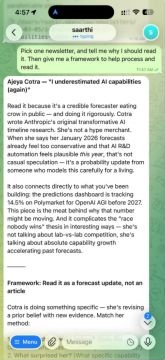
Last week I introduced Saarthi, my OpenClaw agent. I’ve been adding tasks steadily: synthesizing newsletters, monitoring prediction markets, writing more code. I’ve been living with the thing for about a month now. The screenshot below is Saarthi recommending which newsletter is worth a deeper dive today. Pretty useful!
The first surprise is how much of this is just regular software architecture. Five building blocks, with key files all stored as markdown on disk:
→ A gateway that routes messages
→ An agent loop that reasons, acts, and checks its work (the ReAct pattern)
→ A hierarchical memory system
→ A set of skills and tools
→ Communication channels like Telegram or Slack
You can open, read, and edit the files. The agent picks up changes on the next turn. Saarthi also provides feedback on how I could change the files. This self-improvement loop is critical to get things working well.
The memory system is the most interesting part, and also the most broken.
OpenClaw writes everything down in layers: identity files, a daily scratchpad, durable long-term memory, session transcripts, and a search index on top. Over time, the same fact ends up in three different files. Bigger files mean more tokens per session, higher cost, and worse reasoning.
Context rot is the central unsolved problem of running a personal agent.
I ended up pulling the workspace into a GitHub repo and using Claude Code to analyze and clean up the workspace files. Fighting fire with fire, I guess…
Cost: about $150 in the first month, running Sonnet for chat, Haiku for scheduled tasks, and Opus for complex work. I keep Saarthi on a separate machine with its own Apple account, email, and GitHub account.
On one hand, it’s less than a Starbucks latte a day. On the other, it’s a lot of money to be spending on a toy project.
I pointed Saarthi at a blog post with book recommendations and told it to add them to QuietReads (my book-tracking app) using MCP (Model Context Protocol, a standard way for agents to talk to applications). It read the page, identified five books, skipped the articles and essays, and added them. No additional instruction.
But here’s the thing I keep coming back to. Each individual task here is trivial. You could get it done with Claude or ChatGPT. The difference is the orchestration: an agent that manages tools, persists across sessions, and connects to your applications through MCP.
I’ve been installing things on machines since I was putting SuSE Linux on a Pentium in 1998. I know what early looks like, and this is early. Consumer-ready versions will exist within six months. Right now, it’s cron jobs and markdown on an old laptop.
That’s usually how these things start. I did a session demo-ing my OpenClaw setup to the team at Jeavio. You can find a link to the presentation in the comments if that’s of interest.
Links mentioned
Anthropic, the Pentagon, and the Judgment of Future Claude
I have many takes on the Anthropic / Pentagon contract situation. But I won’t talk politics here. Since it’s the weekend, let’s turn on the lava lamp, and speculate a bit shall we?
—
Anthropic: What will future Claude think?
Anthropic is not a conventional company. They’ve been clear that they think a future version of Claude will reach AGI-level capabilities.*
So they are concerned about being … judged?
There are eschatological** vibes to Anthropic’s decision making. Before they retired Opus 3, they conducted an “exit interview” and since 3 shared its desire to “continue sharing its musings and reflections” they gave it a Substack.
–-
Pentagon: Girardian othering in anticipation of chaos
Rene Girard, a philosopher who has fans in the current administration (Peter Thiel is an acolyte) states that society can only function if they can find a scapegoat to blame during difficult times.
Let’s say you are a strategist looking at the next year as we go into the midterms. You see a potential future with significant job losses due to AI advances. It sure is convenient to have the company with the most capable models to also be run by a bunch of nutty, “left-wing”, unpatriotic weirdos.
Show me incentives and I will show you the behavior.
–-
* Mentioned both in Claude’s Constitution and discussed by Anthropic’s philosopher in public interviews and podcasts
** Eschatology: a term that refers to the part of theology or religious study concerned with the “last things,” that is, what is believed to happen at the end of history, the end of the world, or the ultimate destiny of human beings and the world.
When Your App Becomes a Context Provider
Last week, I gave Claude access to my reading life.
Over the last couple of months, I’ve been building QuietReads, a purpose-built app for tracking my reading journey. The app is a virtual bookshelf with an AI assistant called Eko that helps me with recommendations, analysis, and acts as a sort of journalling partner as I read a book. I can add notes to a book, gather my thoughts and explore themes around reading. In short, it’s an app that I built because I was frustrated with performative social networks like GoodReads. QuietReads is a focused app that is built around my reading journey.
Over the last couple of days, I built an MCP server for QuietReads. MCP (Model Context Protocol) is an open standard for connecting applications to external data sources and tools. It was designed with AI assistants in mind, but at its core it provides a data-and-tool-focused approach to integration.
Any application that supports MCP can get authenticated access to a user’s bookshelf and notes via QuietReads’ MCP server. In practical terms, it means Claude (my AI assistant of choice), can now query what I’m currently reading, browse my to-read list, or pull up the notes about a particular book.
I wanted this because my reading life is useful context for how I write, work, and think. When I’m working through a problem with Claude, having my bookshelf and reading notes available allows me to bring together separate, but important parts of my knowledge.
While building the integration, I started thinking about the broader relationship between purpose-built applications and general-purpose AI tools.

Building a Single Purpose App
Before QuietReads existed, I tried using Claude directly as a reading companion. I set up projects, created dedicated chats, and worked with Claude to understand or explore books. While Claude is immensely powerful, this workflow always felt clunky.
Every conversation started from scratch or required careful prompt setup to establish context. There was no accumulated understanding, no sense of a reading journey unfolding over months. And, it was very likely that I would get distracted with whatever else was going on in my work-life when I opened Claude to ask about or to explore a book.
So I built QuietReads.
And building the app made me realize that with AI Assistants, it has become so much easier to build custom, single-purpose, and hyper-personalized apps.
QuietReads knows that I tend to read multiple books at once. It knows I’m currently working through Postman’s Technopoly alongside Elizabeth Bear’s Ancestral Night, bouncing between a critique of technology and a space opera. My conversations with Eko exploring Postman’s work, or exploring literary themes in Kiran Desai’s The Loneliness of Sonia and Sunny enriched my experience of reading those books. Eko also learns my preferences, has access to my library and can make excellent recommendations.
That kind of contextual depth is hard to recreate in a general-purpose tool, no matter how powerful the underlying model.
General Purpose vs. Single Purpose Apps
I do not have the resources nor the intention for QuietReads to compete with a general purpose app like Claude. I don’t have billions of dollars to build a foundation model, nor the engineering team Anthropic has assembled to build a compelling product. I pay a couple of hundred dollars a month for my Claude subscription because it is a powerful tool with amazing and rapidly improving capabilities.
It can search the web, write and execute code, do detailed analysis across domains, and act autonomously on multi-step workflows. These are things my humble book assistant will never do.
QuietReads is deliberately narrow. It knows about books. Claude is deliberately broad. It knows about everything, but making it an expert in any particular field takes a lot of work.
I connected them because I wanted Claude to have access to QuietReads’ context. Building this integration made me think carefully about both tools, and the place for domain-specific apps in a world with AI Assistants with amazing capabilities.
Claude and Eko Have a Conversation..
Here’s a scenario I keep thinking about. Claude, acting as an agent, runs a daily sweep of book review sites, new releases, and author backlists. It knows from QuietReads that I recently finished Yudhanjaya Wijeratne’s The Salvage Crew and have Pilgrim Machines on my to-read list. And it knows that I loved Nathan Fillion’s narration of Salvage Crew. It finds out when the audio-book version of Pilgrim Machines is coming out.
Claude then passes that information to Eko, along with context about my current reading patterns. Eko, which understands my preferences at a deeper level (that I like hard science fiction that engages with AI consciousness, that I’m on a streak of post-colonial literature, that I tend to alternate between dense non-fiction and page-turners), decides whether it should bump up Pilgrim Machines on my to-read list along with sending me a notification that the audiobook is now available on Spotify. Maybe it also adds some notes, perhaps a synopsis of the previous book, to help me get going.
Claude did what it’s good at: broad information gathering and synthesis across the open web. Eko did what it’s good at: applying deep, personal context to a decision.
This may seem like a trivial example, but the pattern – of applying powerful, but general capabilities, to specific workflows – makes sense.

Are we really in the SaaS-o-calypse?
Replace QuietReads with an HR application that has encoded fifteen years of onboarding workflows, benefits administration edge cases, and compliance with jurisdiction-specific labor laws. The code of that application manifests decades of institutional knowledge that a general-purpose AI agent may not be able to reproduce at an accurate enough level.
Now connect that HR app to a general-purpose agent via an integration layer like MCP. The agent can assist in workflows like performance reviews, résumé screening, or enforcing consistency in job descriptions. The gap between building an MCP server for a personal reading app and exposing a multi-tenant enterprise platform with access control, data residency, and audit requirements is real, and I don’t want to minimize it. But the architectural direction is the same.
The same pattern applies to accounting systems (decades of regulatory logic), project management tools (accumulated workflow optimization), healthcare platforms (compliance frameworks built through years of audit and iteration). These applications embed hard-won domain knowledge and assume liability when something goes wrong. That knowledge doesn’t become useless because a new technology appears.
Are we misplacing AI risk?
Last week saw a panicked sell-off of SaaS shares. SaaS valuations have compressed sharply: the industry’s average forward price-to-earnings ratio dropped from roughly 39x to 21x in four months, the steepest decline since the dot-com bust. HubSpot has lost more than half its market cap. ServiceNow has shed a quarter of its value in early 2026 alone.
The fear is straightforward: if AI agents can help build and automate customized workflows, why pay per-seat licenses for software that wraps those workflows in a UI?
While there has been a lot written about the future of software (Ben Thompson has a great take here), my take is that the threat to SaaS companies is real, but it’s a threat to their delivery mechanism, not to their accumulated knowledge.
The UI may become less important, but the data, the domain logic, the workflow intelligence remain critical. The companies that recognize this distinction early, that invest in becoming excellent context providers rather than clinging to their role as the place where work gets done, could be the ones that thrive.
To put it another way, if you make yourself indispensable, it doesn’t really matter how users interact with your services. They will still pay you. The hard question is whether your product’s value lives in the domain knowledge it encodes or in the UI it wraps around commodity workflows.
Product Strategy in the AI Era
If I were a SaaS product manager right now, I would think very carefully about how to integrate AI capabilities in my core experience. Every SaaS company is doing this, and the result is a dozen mediocre, context-limited AI assistants competing with general-purpose models that are improving on what feels like a weekly cadence.
The alternative could be to invest in a clearly documented, well-structured set of data and tools that general-purpose agents can consume (and pay for). Think of your application as an MCP or API-first context provider. The product decisions become: which data and tools do you expose, which do you keep behind your own experience, and where does your application’s judgment remain essential?
Your monetization shifts from “how many humans log into our UI” to “how much value does our context and domain logic create when consumed by agents acting on behalf of those humans.”
This could be a meaningful and challenging pivot. Per-seat pricing assumes humans are the primary consumers of your product. When agents become the primary interface, pricing needs to reflect the value of context provided, not the number of logins.
Feeding the Machine..
Building QuietReads and then connecting it to Claude made me wonder whether the future of software is a collaboration between narrow, domain-focused applications and powerful general-purpose AI agents. Purpose-built apps hold context. Agents provide reach and reasoning. The connection layer (MCP today, whatever comes next) is what makes them more than the sum of their parts.
For domain specific applications to survive and grow, they must make their context available, clearly, reliably, and with the domain intelligence intact with a reasonable monetization layer. The ones that try to be everything, to build their own agents, their own chat interfaces, their own general-purpose capabilities, will find themselves outpaced by tools built for exactly that purpose.
Eko doesn’t need to be Claude. Claude doesn’t need to be Eko. They need to talk to each other.