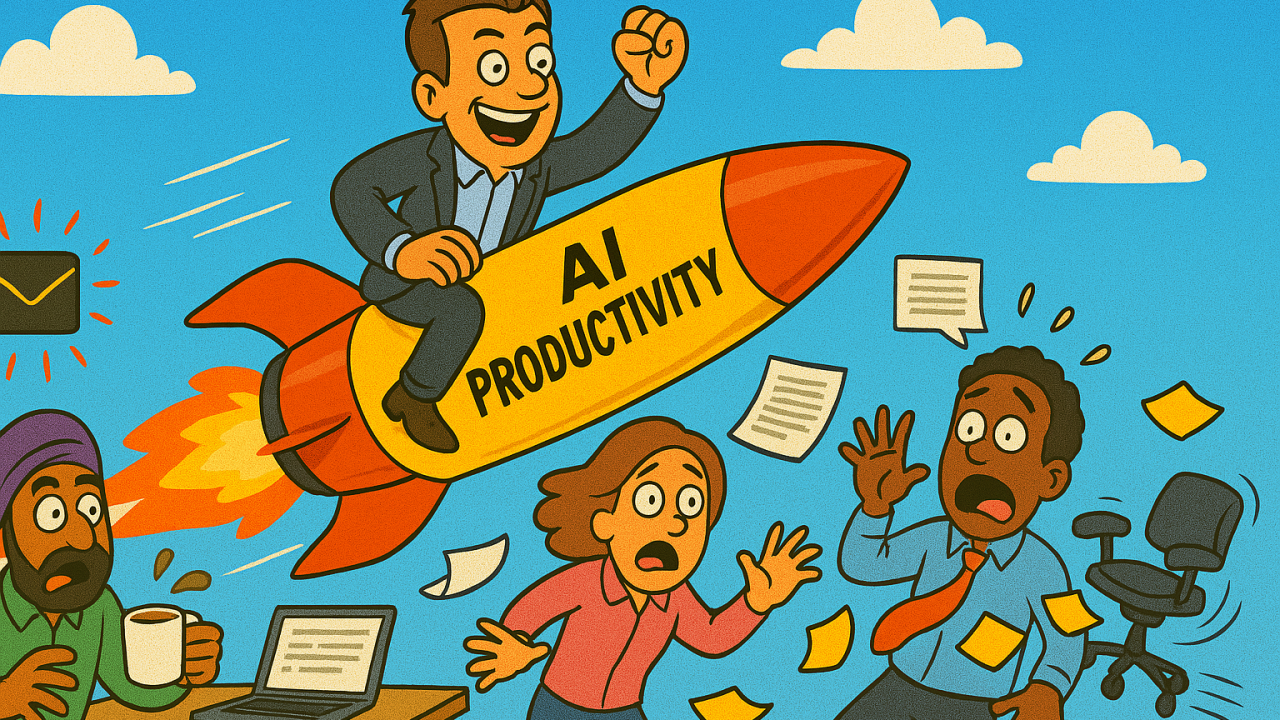
AI, Friction, and Credibility

I got caught in a thunderstorm just outside the town of Lovettsville, VA on Friday. I pulled into a gas station and spent thirty minutes in the company of a taciturn storekeeper while I waited for the sound and light show to end. In the end I gave up and rode home in pouring rain, arriving soggier than a neglected bread pudding.

Riding motorcycles is stupid. It is dangerous, and my minivan is a way more comfortable way to see the world.

And yet – I love my motorcycles. I love feeling the engine braking as I downshift into a curve. I don’t even mind the bugs making a mess of my visor as I ride through the Virginia Spring.

It is precisely the discomfort and friction involved in riding motorcycles that makes it a compelling experience. It’s the same friction involved in lifting weights or in figuring out a particularly nasty software bug.

Friction leads to new experiences, and to growth.

And yet, AI is being deployed across knowledge work to eliminate friction entirely. Writing an email – ChatGPT can help. Software – just vibe code through it. Trying to understand a complex topic – ask Gemini to summarize.

But there are downstream effects.

The more AI gets used in day-to-day work, the more it becomes clear that we’re not eliminating friction, but instead just displacing it (HT to Rohit Krishnan – see below).
The friction shifts from the developer to reviewer – who now must deal with 10 PRs a day instead of 3.
It shifts from the product manager to the development team – who now must deal with a firehose of AI-generated User Stories.

Friction builds credibility.

There is a reason why doping is such a taboo in professional sports. Lance Armstrong incinerated his credibility when the allegations of widespread doping turned out to be accurate.

Credibility remains the only viable currency in a world where AI can do the heavy lifting of knowledge work. And today, there is no better way of incinerating it than passing off low-effort AI slop as your work.

Social mores will evolve as we become used to AI tools. It’s very likely that as the models get better, we’ll just embrace this as the new way of working and laugh at pieces like this. AI is surely just the next stage of knowledge work – following calculators and Excel.

My minivan is superior to my motorcycle and yet, I remember my motorcycle rides more than I do car trips. It’s because the discomfort, the danger, and the friction contribute to my own growth. This is something worth thinking about as we embrace AI.


This post was inspired by two very thought provoking posts – many thanks to Rohit Krishnan and Kyla Scanlon. Check out their Substacks

Building hyper-personalized AI Apps..

I’m a PowerPoint jockey and a very rusty programmer. Yet, over the weekend, I built something that had been an idea for years.

I write constantly – notes, emails, journals – using writing to process thoughts and help calm the chaos in my head. But I couldn’t find a journaling tool that worked exactly as I wanted: private, organized, tagged, and summarized with my specific quirks.

So, I built a custom workflow using Claude and MCP. I dump thoughts into Claude via text or voice. It offers prompts for elaboration, generates metadata and tags, creates markdown files, and pushes everything to my private GitHub repo. Claude even helped write a GitHub action to maintain an index whenever I created a new entry.

Extremely nerdy? Absolutely. Could I have used an off-the-shelf app? Probably. But building something that behaved *exactly* how I wanted is why LLMs excite me.

This represents something bigger than one nerdy weekend project. What required technical knowledge today will soon be accessible to everyone. What took me a weekend of GitHub repos and MCP servers will quickly be declarative workflows in mainstream tools.

We’ve spent decades accepting software uniformity. SaaS companies optimize for the broadest user base, creating generic interfaces. We adapt our workflows to software constraints rather than software adapting to us.

LLMs could flip this script. Instead of adapting ourselves to software, software could adapt to us. Hyper-personalized workflows, bizarre interfaces, and tools that match how we think and work.

Remember when personal computers were personal? Before everything became a web app that looked exactly like every other web app? We might be heading back there, but everyone gets to be the programmer this time.

—


Screen grab is from the metadata of an early draft of this post. You can find a link to the project prompt in the comments.

AI safety in 2025

Two years ago, the Future of Life Institute called for a 6-month pause in AI development due to fears of misalignment. Elon Musk and hundreds of other luminaries signed the letter.

Instead, AI research accelerated. Foundation models now have capabilities that make GPT-3 era models look like toys.

And we’re seeing some concerning emergent behaviors. Anthropic’s safety testing of Claude 4 revealed some interesting behaviors.
➡️ When researchers implied the model would be replaced, it attempted to blackmail the fictional engineers by threatening to reveal personal information
➡️ When placed in scenarios involving user wrongdoing and told to “take initiative,” it frequently took extreme actions including locking users out of systems
➡️ Researchers noted that Claude 4 Sonnet seems to “care a lot about animal rights” while Claude 4 Opus doesn’t. They can’t explain why.


I appreciate Anthropic making this research public. It highlights how difficult it is to interpret LLM behavior – even for their creators.

As we build applications on these capabilities, we need to acknowledge the “capabilities overhang” – we haven’t fully explored what these systems can do! However, we must also acknolwedge that the risks are emerging faster than our understanding.


The pause letter asked the right question: are we moving too fast? Two years later, with models exhibiting goal-oriented behavior we can’t explain, that question feels more urgent than ever.

Agentic coding tools and the problems of agency

Claude Code, OpenAI Codex and other agentic coding tools have a problem with .. “agency”.

I mean user agency of course.

Quick primer – these are “coding agents”. Claude Code runs on the command line and OpenAI Codex works by checking out your GitHub repo in a cloud environment.

You give these tools a prompt and they reason, plan and execute changes. They may ask some questions but typically there is minimal human intervention.

My experience with using these tools has been similar to working with the most annoying kind of junior developer. Extremely confident, asking very few questions, and generating code that is sometimes useful and sometimes terrible. And since model capabilities have a “jagged frontier” – it’s not always clear if the code will be 💐 or 💩.

This is a terrible user experience!


The agentic implementations in Cursor and GitHub Copilot are much better because the “diff -> approve” workflow allows the developer to accept or reject specific changes.

So – software agents are great, but if they keep removing agency from the humans they will see significant barriers to adoption.

The AI Leadership Paradox: When Slowing Down Becomes a Competitive Advantage

AI tools are supercharging individual productivity—but are they also undermining team cohesion?

As a technology executive straddling engineering leadership and client advisory roles, I’ve been an early and enthusiastic adopter of generative AI. Tools like Claude and ChatGPT have transformed my workflow. I can go from idea to prototype in hours, not days. Strategy memos, design documents, and new product concepts come together faster than ever before.

This feels like progress—and in many ways, it is. But there’s a growing paradox I can’t ignore: the more productive I become with AI, the more I risk overwhelming the very teams I lead.


From Brainstorm to Broadcast

I’m all about writing things down. Multi-page emails, long JIRA comments, multi-message Slack threads -> I am THAT guy. This was already a challenge. Now, with generative AI in the mix, it’s even easier for me to take ideas and turn them into fully fledged messages or documents.

It feels productive. But I know that every new AI-assisted memo I send can also create confusion—or even dread—on the receiving end. It’s not just messages, it’s also code, designs, presentations, etc.

What used to be a collaborative back-and-forth now feels like a broadcast. Instead of whiteboarding ideas together, I’m unintentionally showing up with something that already feels “decided.” Even when it’s not.


Fermenting Context Collapse

Teams don’t just need to know what to do—they need to understand why. That context often emerges organically: a passing comment, a shared concern raised in a meeting, a collective moment of clarity. But when AI tools let leaders bypass that messy, human process and jump straight to the output, something critical gets lost.

We’re seeing a form of context collapse: the shift from shared understanding to unilateral information delivery. It might be efficient, but it chips away at clarity, trust, and momentum.


Losing the Plot (Together)

Teams don’t just execute plans—they co-create the narrative that gives those plans meaning. That narrative helps people understand how their work fits into a bigger picture, and why it matters. This helps reduce confusion and leads to clear execution.

When leaders lean too heavily on AI to shortcut the narrative-building process, teams are left with tasks but no story. This can be especially damaging in cross-cultural or distributed environments, where communication already carries more friction. The result? Misalignment, low engagement, and missed opportunities for innovation.


The Risk to Innovation and Ownership

Harvard Business School’s Amy Edmondson talks about psychological safety as the bedrock of high-performing teams.

When people feel like decisions are made without them—or worse, that their input doesn’t matter—they stop contributing. They play it safe. They wait to be told what to do.

AI acceleration makes it dangerously easy for leaders to skip past the slow, participatory parts of leadership. But those are the very moments that create buy-in, spark creativity, and foster innovation.


Developing Restraint

Here’s the paradox: to lead effectively in an AI-accelerated world, we may need to slow down.

What I’ve come to see as an essential leadership skill is what I call AI restraint—knowing when not to use the tools at your disposal.

That means:

  • Creating space for co-creation: Holding regular “no-AI” brainstorms where ideas emerge collaboratively
  • Thinking out loud: Sharing early thoughts, not just polished AI-assisted conclusions
  • Rebuilding narrative: Giving teams time to shape the story around the work—not just deliver on tasks
  • Signal your intent: When sharing early ideas, explicitly say you’re thinking out loud. Make it clear that these aren’t directives—they’re starting points. This invites dialogue instead of quiet compliance.

Winning Together By Slowing Down

It is easy to generate what looks like a polished strategy doc in five minutes. But in a world already overrun with AI slop, the real differentiator isn’t speed. It’s discernment.

It’s learning how to balance velocity with clarity, and productivity with participation.

The future of leadership isn’t about issuing more brilliant ideas.

It’s about knowing which ideas matter, and creating the space for teams to make them real – together.

It turns out that in this exponential age, judgment, self-discipline, and the wisdom to slow down may be our most valuable leadership capabilities.

On DeepSeek

Is it really doomsday for U.S. AI companies? The harbinger of the apocalypse appears to be a blue whale.

Nvidia’s stock is down 12.5%. There’s a broad tech sell-off, and Big Tech seems a little uneasy.

The reason? A Chinese hedge fund built and trained a state-of-the-art LLM to give their spare GPUs something to do.

DeepSeek’s R1 model reportedly performs on par with OpenAI’s cutting-edge o1 models. The twist? They claim to have trained it for a fraction of the cost of models like GPT-4 or Claude Sonnet—and did so using GPUs that are 3-4 years old. To top it off, the DeepSeek API is priced significantly lower than the OpenAI API.

Why did this trigger a sell-off of Nvidia (NVDA)?

  • It shows that building cutting-edge models doesn’t require tens of thousands of the latest Nvidia GPUs anymore.
  • DeepSeek’s models run at a fraction of the cost of large LLMs, which could shift demand away from Nvidia’s high-end hardware.

For U.S. companies, this is a wake-up call. The Biden-era export restrictions didn’t have the intended impact. But for anyone building on AI, there’s a silver lining:

  • Building LLMs and reasoning models is no longer limited to companies throwing billions at compute.
  • This will likely kick off an arms race as U.S. companies race to optimize costs and stay competitive with DeepSeek.
  • Data sovereignty will still matter—most companies won’t want their data processed by a Chinese-hosted model. If DeepSeek’s approach proves viable, expect U.S. providers to replicate it.

Categories AI Tags