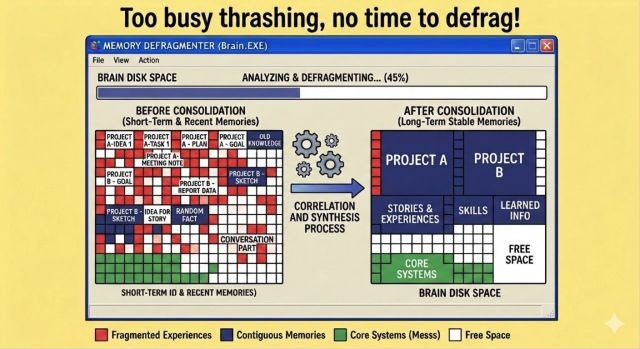
I’ve spent the couple of years helping teams adopt AI tools while using them heavily myself. One pattern keeps showing up, and I don’t think we’re talking about it enough. And honestly it reminds me of using an old Windows XP computer. Bear with me.
AI tools make it possible to run more workstreams simultaneously than ever before. Context lives in chat transcripts. Notes get synthesized on demand. A senior developer on my team described the workflow honestly in a recent Slack message: “apologies – while working on AI application, I also started acting like LLM. New day requires new context.”
He was joking. But he was also describing something real.
If, like me, you are old enough to have experienced a Windows XP machine “thrashing” – trying to write and load memory from disk – you’ll recognize this pattern. Thrashing is when a system is technically functional but spending most of its cycles swapping context in and out of memory instead of doing useful computation. The machine looks busy. Output is fine. But there is significant overhead.
That’s what I’m seeing across teams and, if I’m honest, in my own work. People are using AI as swap memory. And it works well enough for any individual task. The cost shows up between tasks.
For consultants, engineering leaders, anyone whose value comes from pattern recognition across projects: synthesis doesn’t happen at your desk. It happens when you’re walking the dog, staring out a window, sleeping. Your brain builds connections across the day’s scattered inputs during idle time. Synthesis is defrag.
But if context goes straight to an AI tool and never enters your own memory, there’s nothing to defragment. The connections never form.
The work on each task is sharp. What erodes is the connective tissue between tasks, the ability to spot a pattern in one project because you’re carrying context from another.
I call this exchanging insight for output.
The short-term productivity gains are real. I don’t know how to measure what they cost over months and years. But for anyone whose value depends on seeing across their work rather than within it, I’m convinced the cost is real.