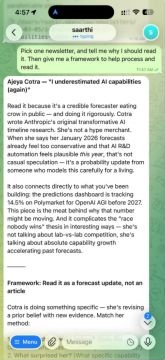
Last week I introduced Saarthi, my OpenClaw agent. I’ve been adding tasks steadily: synthesizing newsletters, monitoring prediction markets, writing more code. I’ve been living with the thing for about a month now. The screenshot below is Saarthi recommending which newsletter is worth a deeper dive today. Pretty useful!
The first surprise is how much of this is just regular software architecture. Five building blocks, with key files all stored as markdown on disk:
→ A gateway that routes messages
→ An agent loop that reasons, acts, and checks its work (the ReAct pattern)
→ A hierarchical memory system
→ A set of skills and tools
→ Communication channels like Telegram or Slack
You can open, read, and edit the files. The agent picks up changes on the next turn. Saarthi also provides feedback on how I could change the files. This self-improvement loop is critical to get things working well.
The memory system is the most interesting part, and also the most broken.
OpenClaw writes everything down in layers: identity files, a daily scratchpad, durable long-term memory, session transcripts, and a search index on top. Over time, the same fact ends up in three different files. Bigger files mean more tokens per session, higher cost, and worse reasoning.
Context rot is the central unsolved problem of running a personal agent.
I ended up pulling the workspace into a GitHub repo and using Claude Code to analyze and clean up the workspace files. Fighting fire with fire, I guess…
Cost: about $150 in the first month, running Sonnet for chat, Haiku for scheduled tasks, and Opus for complex work. I keep Saarthi on a separate machine with its own Apple account, email, and GitHub account.
On one hand, it’s less than a Starbucks latte a day. On the other, it’s a lot of money to be spending on a toy project.
I pointed Saarthi at a blog post with book recommendations and told it to add them to QuietReads (my book-tracking app) using MCP (Model Context Protocol, a standard way for agents to talk to applications). It read the page, identified five books, skipped the articles and essays, and added them. No additional instruction.
But here’s the thing I keep coming back to. Each individual task here is trivial. You could get it done with Claude or ChatGPT. The difference is the orchestration: an agent that manages tools, persists across sessions, and connects to your applications through MCP.
I’ve been installing things on machines since I was putting SuSE Linux on a Pentium in 1998. I know what early looks like, and this is early. Consumer-ready versions will exist within six months. Right now, it’s cron jobs and markdown on an old laptop.
That’s usually how these things start. I did a session demo-ing my OpenClaw setup to the team at Jeavio. You can find a link to the presentation in the comments if that’s of interest.